How to use this calculator
Model a single-server queue with a finite total capacity and lost arrivals when full.
- Enter Offered arrival rate per hour, Service rate per hour, System capacity including service. Match the units shown beside each field and review the result together with the assumptions below.
- Read the worked example below to check the expected input format and result.
- Compare another scenario by changing one input at a time. Use Reset to return to the starting values.
Finite capacity M M 1 K queue explained
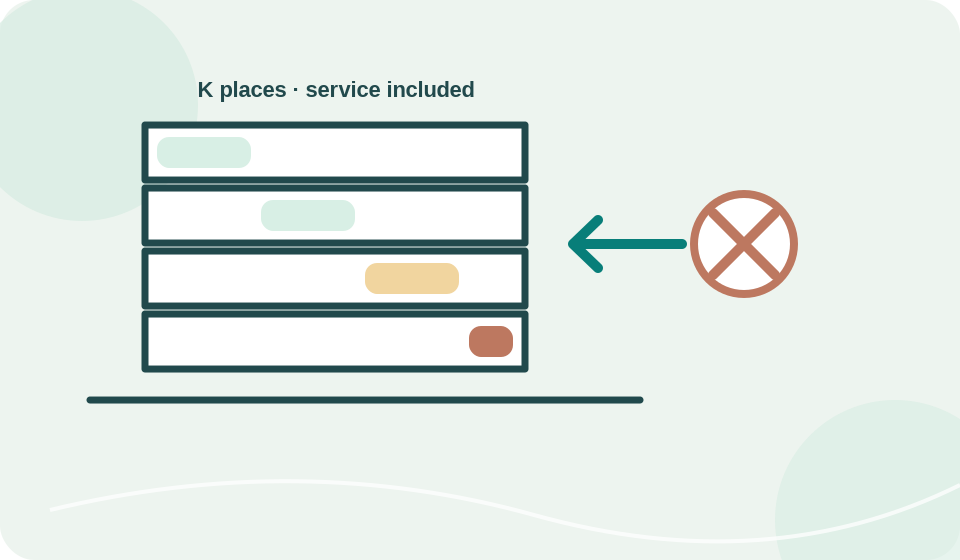
Enter offered Poisson arrivals, one server’s exponential service rate, and K total system places to estimate blocking; K includes the customer in service, and λ may exceed μ for finite K.
A numerical walkthrough
Offered arrival rate per hour = 8; Service rate per hour = 10; System capacity including service = 5.
- Arrival blocking probability: 0.0888195
- Effective accepted arrival rate: 7.289444 per hour
- Mean number in system: 1.868332
- Mean accepted-customer system time: 15.378391 minutes
At arrival/service ratio 0.8 and capacity 5, the state weights are 1, 0.8, 0.64, 0.512, 0.4096, and 0.32768 before normalization.
The model behind the numbers
Truncated geometric stationary probabilities
Stationary state weights are proportional to rho^n for n=0…K. Log-scaled normalization avoids overflow; blocking probability is the full-state probability. Accepted throughput is lambda(1−PK), and Little’s law then gives accepted-customer system time.
What to enter
l— Offered arrival rate per hour- Poisson arrival rate on the same hourly basis as service; attempted arrivals finding all K places occupied are blocked.
m— Service rate per hour- Exponential completion rate for the single server, expressed per hour.
k— System capacity including service- Maximum customers in the system, including the one in service and any waiting customers. For K=5, at most five customers are present. Enter a whole number.
Interpreting the result
Poisson arrivals, exponential service, first-come service, and no waiting outside the modeled capacity.
Frequently asked questions
Does K include the customer in service?
Yes.
Must arrival rate be below service rate?
Not for a finite-capacity stationary model.
Are blocked arrivals delayed?
No, they are lost.
How do I use the Finite capacity M M 1 K queue calculator?
Enter Offered arrival rate per hour, Service rate per hour, System capacity including service. Match the units shown beside each field and review the result together with the assumptions below.
What is a worked example of Finite capacity M M 1 K queue?
Offered arrival rate per hour = 8; Service rate per hour = 10; System capacity including service = 5. Arrival blocking probability: 0.0888195 Effective accepted arrival rate: 7.289444 per hour Mean number in system: 1.868332 Mean accepted-customer system time: 15.378391 minutes At arrival/service ratio 0.8 and capacity 5, the state weights are 1, 0.8, 0.64, 0.512, 0.4096, and 0.32768 before normalization.
Queue model reference: Sztrik, Basic Queueing Theory, Section 2.4 derives the finite-capacity M/M/1/K state probabilities and notes that finite K permits a stationary distribution for λ/μ above one.
Read our calculation methodology.