How to use this calculator
Estimate blocking probability in a multi-server loss system where arrivals finding all servers busy are rejected.
- Enter Offered traffic (Erlangs), Parallel servers with no waiting room. Match the units shown beside each field and review the result together with the assumptions below.
- Read the worked example below to check the expected input format and result.
- Compare another scenario by changing one input at a time. Use Reset to return to the starting values.
Erlang B loss system blocking explained
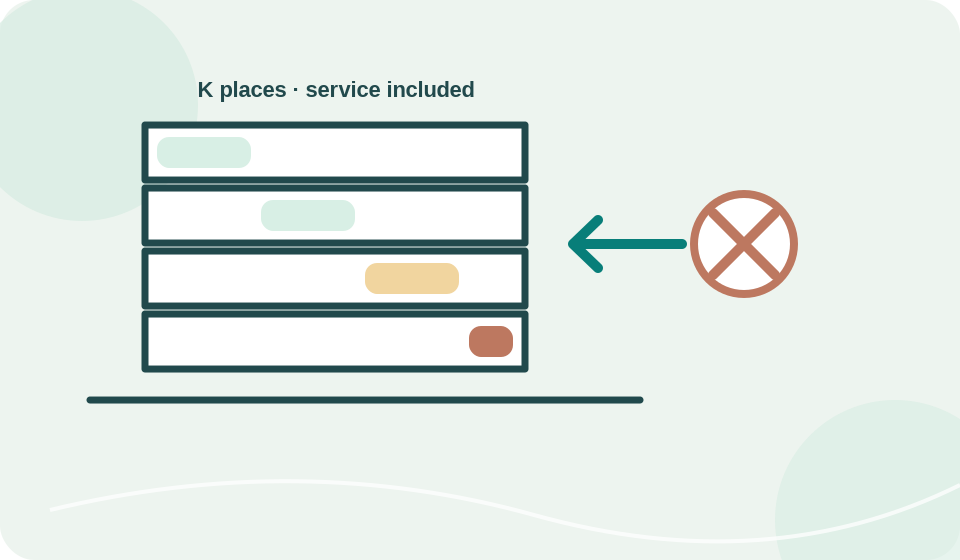
The Erlang B recursion computes the probability that all identical servers are busy when Poisson arrivals have no waiting room. Offered traffic is measured in Erlangs; carried traffic is offered traffic multiplied by one minus the blocking probability.
Inputs, symbols, and units
a— Offered traffic (Erlangs)- Offered traffic (Erlangs).
n— Parallel servers with no waiting room- Parallel servers with no waiting room. Enter a whole number.
Formula and method
B₀=1; Bₙ = A Bₙ₋₁/(n + A Bₙ₋₁). Carried traffic = A(1 − Bₙ).
Poisson arrivals, independent holding times, identical servers, and no waiting or retrial traffic feedback.
A worked scenario
Offered traffic (Erlangs) = 10; Parallel servers with no waiting room = 12.
- Blocking probability: 0.11973919
- Carried traffic: 8.802608 Erlangs
For A=10 Erlangs and 12 servers, the recursion gives B₁₂≈0.119739. Carried traffic is 10×(1−0.119739)≈8.80261 Erlangs; the blocked share is about 11.97%.
Assumptions and edge cases
Poisson arrivals, independent holding times, identical servers, and no waiting or retrial traffic feedback.
Frequently asked questions
How is it different from Erlang C?
Erlang B rejects blocked arrivals; Erlang C queues them.
What are Erlangs?
Offered arrival rate times mean holding duration in consistent time units.
Can I model retries automatically?
No.
How do I use the Erlang B loss system blocking calculator?
Enter Offered traffic (Erlangs), Parallel servers with no waiting room. Match the units shown beside each field and review the result together with the assumptions below.
What is a worked example of Erlang B loss system blocking?
Offered traffic (Erlangs) = 10; Parallel servers with no waiting room = 12. Blocking probability: 0.11973919 Carried traffic: 8.802608 Erlangs For A=10 Erlangs and 12 servers, the recursion gives B₁₂≈0.119739. Carried traffic is 10×(1−0.119739)≈8.80261 Erlangs; the blocked share is about 11.97%.
Read our calculation methodology.