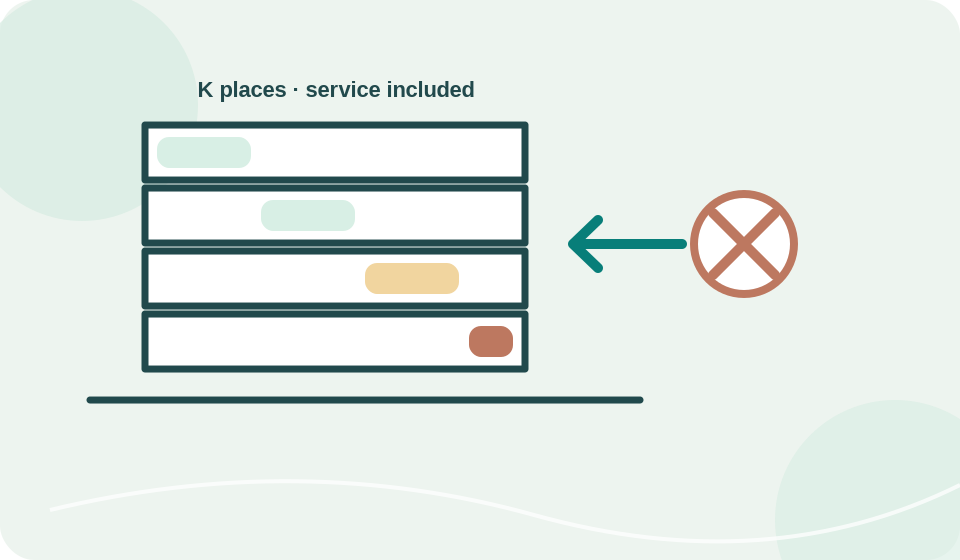

Define capacity as a total system limit
The calculator accepts an offered arrival rate λ per hour, a service rate μ per hour, and integer system capacity K. K includes the position being served. Thus K=1 permits one customer in service and no one waiting; K=5 permits one in service and up to four waiting. Arrivals that find all K positions occupied are blocked and do not join an outside queue in this model.
The first M denotes Markovian, memoryless arrivals; the second M denotes exponential service durations; 1 means one server; K is the finite population capacity of the queueing system, not a count of waiting places alone. The model assumes Poisson arrivals, independent exponential service, and first-come service. If requests wait elsewhere or retry after rejection, that behavior is outside the calculation.
Compute the stationary capacity probabilities
For positive arrival and service rates, define ρ=λ/μ. The stationary probability of i customers is proportional to ρⁱ for i=0,…,K, then normalized: Pᵢ=ρⁱ/Σⱼ₌₀ᴷρʲ. The arrival blocking probability is Pₖ because an arrival sees a full system under the model's Poisson-arrival assumptions. The accepted arrival rate is λeff=λ(1−Pₖ), and the mean number inside is L=Σ iPᵢ.
Little's Law then gives mean time in the system W=L/λeff. The calculator reports minutes, so it multiplies the hours-per-customer ratio by 60. This is system time, including any time waiting plus service; it is not queue waiting alone. At zero offered arrivals the tool returns zero for blocking, accepted rate, and mean number, while the accepted-customer time is undefined because there are no accepted customers to average.
Worked examples
Five total places, including service
Inputs: Offered arrival rate λ = 8/hour; service rate μ = 10/hour; total system capacity K = 5.
Calculation: ρ=0.8 and Pᵢ=ρⁱ/Σⱼ₌₀⁵ρʲ. P₅=0.08881950; λeff=8(1−P₅)=7.289444/hour; L=1.868332. W=L/λeff×60=15.378391 minutes.
About 8.88% of arrivals are blocked; accepted arrivals spend about 15.38 minutes in the finite system on average.
More arrivals than service capacity with a finite limit
Inputs: Offered arrival rate λ = 12/hour; service rate μ = 10/hour; total system capacity K = 4.
Calculation: ρ=1.2 and Pᵢ=ρⁱ/Σⱼ₌₀⁴ρʲ. P₄=0.27864975; λeff=12(1−P₄)=8.656203/hour; L=2.359493. W=L/λeff×60=16.354695 minutes.
The finite system remains bounded by rejecting arrivals when full; about 27.86% are blocked in the steady-state model.

Interpret a lightly loaded finite buffer
With λ=8 per hour, μ=10 per hour, and K=5, the state probabilities give P₅≈0.08881950. Accepted traffic is 8(1−0.08881950)=7.289444 per hour, and L≈1.868332 customers. Therefore W=1.868332/7.289444 hours × 60≈15.378 minutes. Service itself averages 60/10=6 minutes; the rest is queue delay averaged over accepted arrivals, not a separate calculator output.
Now increase arrivals to 12 per hour while keeping μ=10 and K=4. An infinite-capacity M/M/1 queue would be unstable at ρ>1, but this finite Markov chain still has a stationary distribution because full arrivals are rejected. It gives P₄≈0.27864975, λeff≈8.656203/hour, L≈2.359493, and W≈16.355 minutes. The higher offered rate is partly absorbed as blocking rather than unlimited growth.
Read blocking, throughput, and time together
Likewise, accepted arrival rate is throughput into the modeled system, while mean number and mean accepted-customer time describe occupancy and experience among traffic that enters. Keep the measures paired when comparing buffer sizes.
The accepted time follows Little's Law only when L and λeff refer to the same steady-state population and interval. A common mistake is to divide L by offered λ when some arrivals are blocked; that understates the average system time for accepted customers. Another is to treat K as waiting capacity, which changes the result by one place when the in-service customer is omitted.
Use the finite model as a bounded approximation
The assumptions matter when the service rate varies by job, arrivals are scheduled or bursty, or customers abandon the buffer. Exponential service has a memoryless duration; a nearly deterministic process can have very different occupancy probabilities. The calculator also does not model overflow routing, retries, priority classes, multiple servers, or work left outside the system. If blocked work simply waits in another physical queue, the modeled K is not the complete system.
Test a few nearby K values to see whether a small buffer change materially alters blocking and delay. Verify that λ and μ are both expressed per hour; entering a rate per minute as though it were per hour changes the ratio by a factor of 60. For a one-server queue with unlimited waiting space, compare with the M/M/1 queue model; that infinite-buffer model requires λ<μ.