How to use this calculator
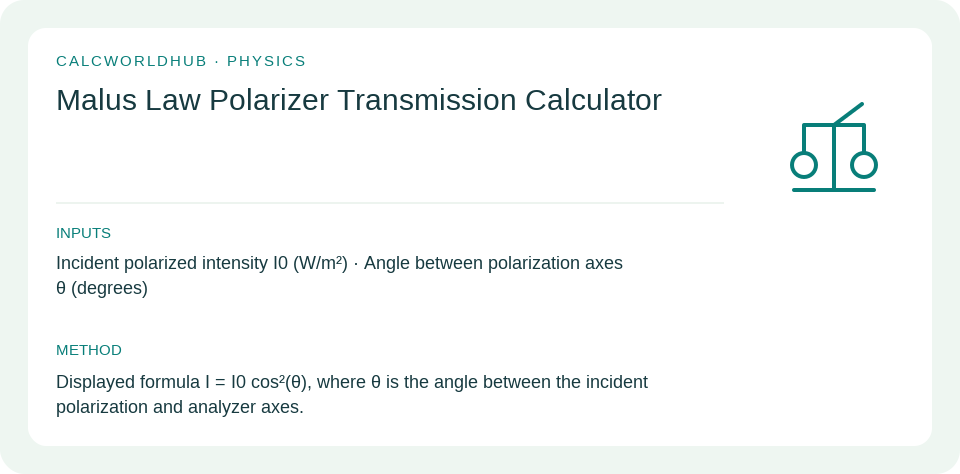
Calculate the intensity transmitted by an analyzer from polarized light and the angle between their axes.
- Enter Incident polarized intensity I0 (W/m²), Angle between polarization axes θ (degrees). Match the units shown beside each field and review the result together with the assumptions below.
- Read the worked example below to check the expected input format and result.
- Compare another scenario by changing one input at a time. Use Reset to return to the starting values.
How this calculation works
Malus’s law gives the transmitted intensity after an ideal analyzer. The electric-field component parallel to the analyzer axis passes through, so intensity scales with the squared cosine of the angle.
Inputs and units
intensity— Incident polarized intensity I0 (W/m²)- Intensity of the linearly polarized light just before the analyzer.
angle— Angle between polarization axes θ (degrees)- Angle between the incoming electric-field direction and analyzer axis.
Formula
I = I0 cos²(θ), where θ is the angle between the incident polarization and analyzer axes.
Method
Enter the linearly polarized intensity immediately before the analyzer and the smallest axis angle in degrees. The calculation uses ideal polarizers and returns the remaining intensity and transmission fraction.
Worked example
For 1,000 W/m² of polarized light and a 30° analyzer angle, Malus’s law gives 750 W/m² transmitted, or 75% of the incident intensity.
Assumptions and limits
The incident beam must already be linearly polarized. For unpolarized light passing through an ideal first polarizer, use half the source intensity as I0. Real filters have finite transmission and extinction ratios, which are not modeled.
Frequently asked questions
What angle should I enter?
Enter the angle between the incoming polarization direction and the analyzer axis, not the angle from the beam direction.
What happens at 90°?
The axes are crossed, so an ideal analyzer transmits zero intensity.
What if the original source is unpolarized?
An ideal first polarizer transmits half of unpolarized source intensity. Use that transmitted value as I0 before entering the analyzer angle.
How do I use the Malus Law Polarizer Transmission Calculator?
Enter Incident polarized intensity I0 (W/m²), Angle between polarization axes θ (degrees). Match the units shown beside each field and review the result together with the assumptions below.
What is a worked example of Malus Law Polarizer Transmission?
For 1,000 W/m² of polarized light and a 30° analyzer angle, Malus’s law gives 750 W/m² transmitted, or 75% of the incident intensity.
Reference: OpenStax University Physics explanation of Malus law for analyzer transmission. See our calculation methodology.