Manufacturing cycle efficiency calculator
Compare value-added processing time with total lead time over the same production flow.
inputs.
How to use this calculator
Compare value-added processing time with total lead time over the same production flow.
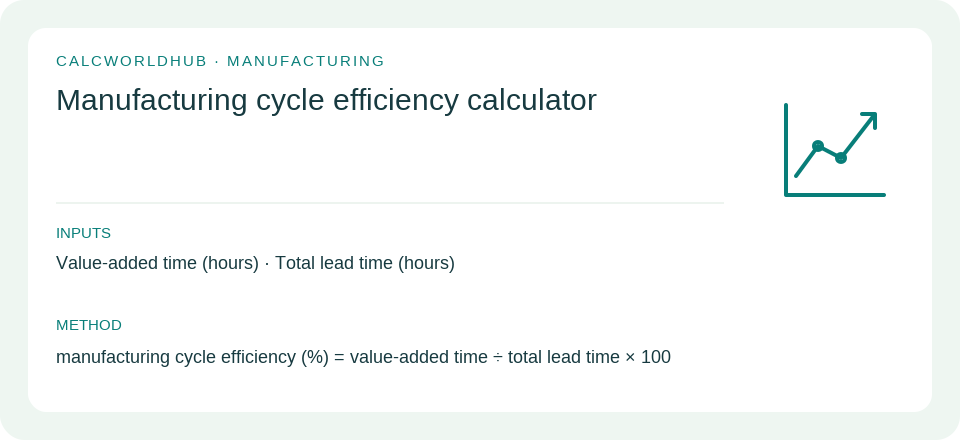
- Enter Value-added time (hours), Total lead time (hours). Match the units shown beside each field and review the result together with the assumptions below.
- Read the worked example below to check the expected input format and result.
- Compare another scenario by changing one input at a time. Use Reset to return to the starting values.
How the Manufacturing cycle efficiency calculator works
Compare value-added processing time with total lead time over the same production flow.
Inputs and units
- Value-added time (hours): Time spent on work classified as value-adding, in hours.
- Total lead time (hours): Total elapsed lead time for that same process scope, in hours.
Formula and method
manufacturing cycle efficiency (%) = value-added time ÷ total lead time × 100
Worked example
3.5 value-added hours ÷ 16 lead-time hours × 100 = 21.875%.
Interpreting the result
The remaining share represents time not counted as value-added under the chosen process definition; it may include waiting, movement, inspection, or storage.
Assumptions and limits
Define the process boundary and value-added activities consistently. This ratio does not measure product quality or customer value directly, and value-added time should not exceed total lead time.
Frequently asked questions
What does the non-value-added share represent?
It is the portion of the stated lead time not classified as value-added by the reporting method; investigate its components before drawing conclusions.
Can this ratio exceed 100%?
Not if value-added time is a subset of the same total lead-time interval; a higher result indicates inconsistent definitions or periods.
How do I use the Manufacturing cycle efficiency calculator?
Enter Value-added time (hours), Total lead time (hours). Match the units shown beside each field and review the result together with the assumptions below.
What is a worked example of Manufacturing cycle efficiency?
3.5 value-added hours ÷ 16 lead-time hours × 100 = 21.875%.
What does the Manufacturing cycle efficiency calculator calculate?
Compare value-added processing time with total lead time over the same production flow.
See the calculation methodology.