Mean margin of error calculator
Estimate a mean’s margin of error from a critical multiplier, sample standard deviation, and sample size.
Calculator
How to use this calculator
Estimate a mean’s margin of error from a critical multiplier, sample standard deviation, and sample size.
- Enter Critical value, Sample standard deviation, Sample size n. Match the units shown beside each field and review the result together with the assumptions below.
- Read the worked example below to check the expected input format and result.
- Compare another scenario by changing one input at a time. Use Reset to return to the starting values.
Mean margin of error calculator
Estimate a mean’s margin of error from a critical multiplier, sample standard deviation, and sample size.
What it measures
The standard error is s/√n. Multiplying it by the selected critical value gives a symmetric margin around a sample mean.
Inputs and units
- Critical value: Dimensionless z or t critical multiplier appropriate to the chosen interval and degrees of freedom.
- Sample standard deviation: Sample standard deviation in the measured units.
- Sample size n: Positive whole-number sample size.
Formula and method
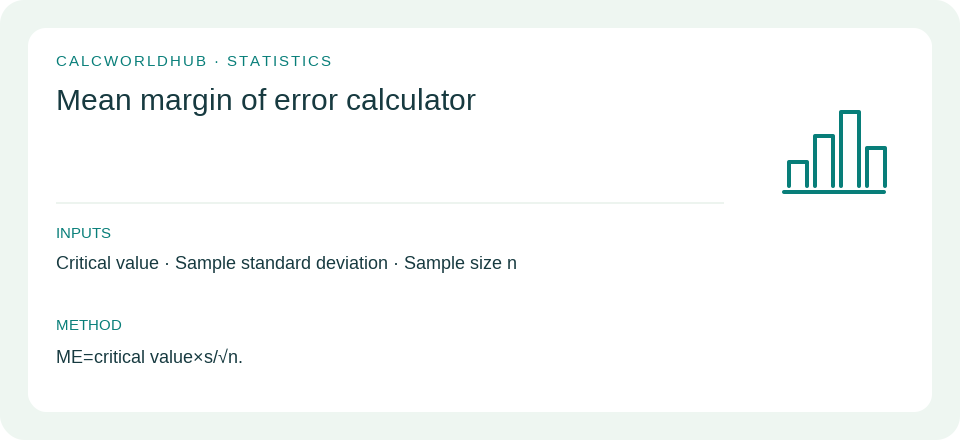
ME=critical value×s/√n.
Worked example
With critical value 1.96, s=12, and n=36, ME=1.96×12/6=3.92 units.
Interpreting the result
The margin is a half-width; an interval would be estimate ±3.92. The critical multiplier depends on the intended confidence level and distribution assumptions.
Assumptions and limits
The formula assumes independent observations and a suitable critical value. For a small sample with unknown population spread, a Student t multiplier is typically used instead of a normal z value.
Sources and method
- Gives t-based mean confidence limits using s/√n and the one-sample t statistic; relevant to standard error and margin-of-error context. NIST: Confidence limits for the mean
Frequently asked questions
Is margin of error the full interval width?
No. It is the distance from the estimate to either endpoint; full width is twice the margin.
Should I always use 1.96?
No. It is the approximate 95% normal critical value; other confidence levels or small samples use a different value.
How do I use the Mean margin of error calculator?
Enter Critical value, Sample standard deviation, Sample size n. Match the units shown beside each field and review the result together with the assumptions below.
What is a worked example of Mean margin of error?
With critical value 1.96, s=12, and n=36, ME=1.96×12/6=3.92 units.
What does the Mean margin of error calculator calculate?
Estimate a mean’s margin of error from a critical multiplier, sample standard deviation, and sample size.
See the calculation methodology.
Good calculators show their work.
CalcWorldHub is built around clear inputs and visible assumptions. Results are estimates for planning; check official sources or your provider’s terms when exact figures matter.