How to use this calculator
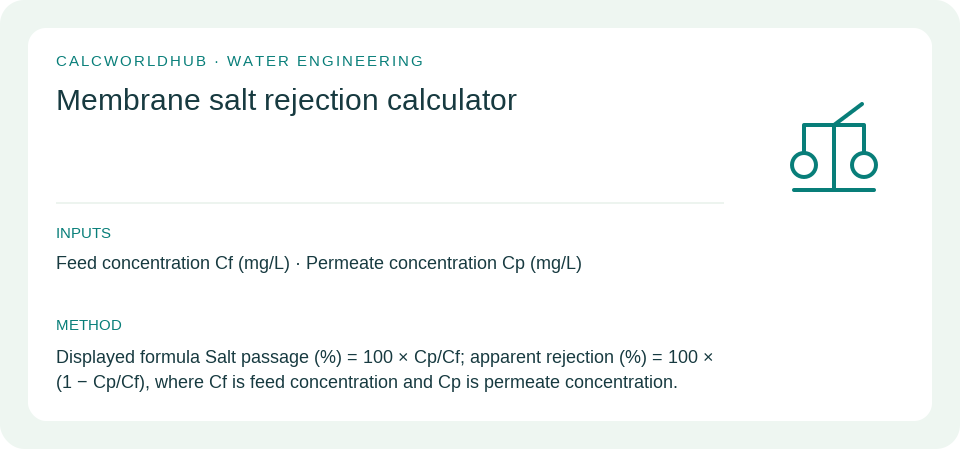
Estimate observed membrane salt rejection and passage from feed and permeate concentration measurements.
- Enter Feed concentration Cf (mg/L), Permeate concentration Cp (mg/L). Match the units shown beside each field and review the result together with the assumptions below.
- Read the worked example below to check the expected input format and result.
- Compare another scenario by changing one input at a time. Use Reset to return to the starting values.
How this calculation works
A simple membrane performance check compares the same dissolved constituent in feedwater and permeate. The ratio describes concentration rejection for the measured samples; it is not a log-removal value or a normalized membrane rating.
Inputs and units
cf— Feed concentration Cf (mg/L)- Concentration of the selected dissolved constituent in feedwater.
cp— Permeate concentration Cp (mg/L)- Concentration of the same constituent in permeate; use the same units as feed.
Formula
Salt passage (%) = 100 × Cp/Cf; apparent rejection (%) = 100 × (1 − Cp/Cf), where Cf is feed concentration and Cp is permeate concentration.
Method
Divide the measured permeate concentration by feed concentration to obtain passage, then subtract that fraction from one for apparent rejection. Both measurements must use the same analyte and concentration units.
Worked example
If feed TDS is 35,000 mg/L and permeate TDS is 350 mg/L, passage is 1.0% and apparent rejection is 99.0%.
Assumptions and limits
This is an observed concentration ratio for the entered samples. It does not normalize for temperature, pressure, recovery, concentration polarization, or sampling conditions. A negative rejection can occur when permeate concentration exceeds feed concentration and should prompt a data or operating-condition review.
Frequently asked questions
Can feed and permeate use different units?
No. Convert both concentrations to the same units before calculating the ratio.
Why can the rejection result be negative?
If permeate concentration is higher than feed concentration, the arithmetic reports negative apparent rejection. Check sampling, units, recovery, and process conditions.
Is this a normalized RO performance rating?
No. It is a direct measured ratio. Normalized performance comparisons account for operating conditions such as temperature, pressure, and recovery.
How do I use the Membrane salt rejection calculator?
Enter Feed concentration Cf (mg/L), Permeate concentration Cp (mg/L). Match the units shown beside each field and review the result together with the assumptions below.
What is a worked example of Membrane salt rejection?
If feed TDS is 35,000 mg/L and permeate TDS is 350 mg/L, passage is 1.0% and apparent rejection is 99.0%.
Reference: U.S. EPA pollutant loading and wastewater flow methodology. See our calculation methodology.