How to use this calculator
Close water and dissolved-salt balances across one membrane stage using an explicitly defined observed rejection and water recovery.
- Enter Feed flow (m³/hour), Feed salt concentration (mg/L), Permeate water recovery fraction, Observed feed based salt rejection fraction. Match the units shown beside each field and review the result together with the assumptions below.
- Read the worked example below to check the expected input format and result.
- Compare another scenario by changing one input at a time. Use Reset to return to the starting values.
Single stage membrane recovery salt balance explained
Recovery partitions feed flow into permeate and concentrate. Apply observed salt rejection to the permeate concentration, then conserve salt mass between feed, permeate and concentrate to solve the concentrate value.
Inputs, symbols, and units
Q— Feed flow (m³/hour)- Total water entering one membrane stage.
C— Feed salt concentration (mg/L)- Feed concentration for the represented dissolved salt.
Y— Permeate water recovery fraction- Fraction of feed water leaving as permeate; strictly below complete recovery.
R— Observed feed based salt rejection fraction- Defined by 1−Cp/Cfeed, not by a local membrane-surface concentration.
Formula and method
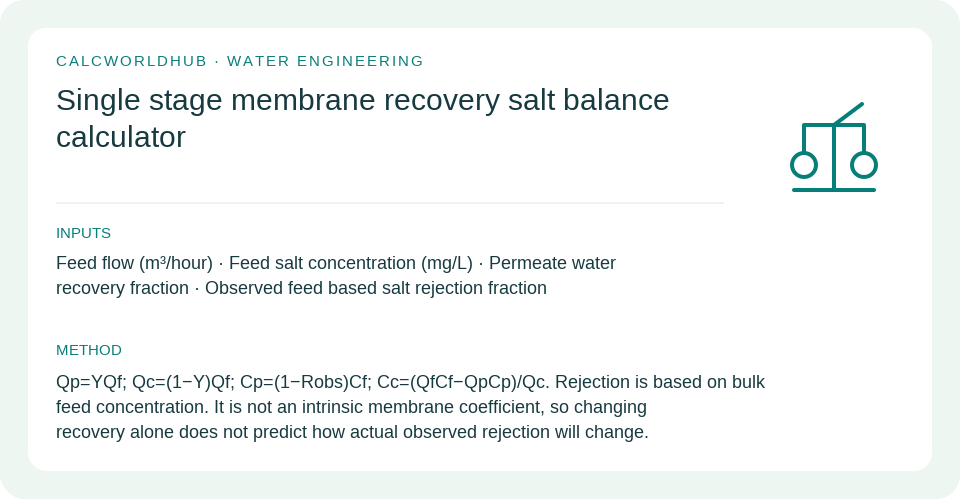
Qp=YQf; Qc=(1−Y)Qf; Cp=(1−Robs)Cf; Cc=(QfCf−QpCp)/Qc.
Rejection is based on bulk feed concentration. It is not an intrinsic membrane coefficient, so changing recovery alone does not predict how actual observed rejection will change.
A worked scenario
Feed flow (m³/hour) = 100; Feed salt concentration (mg/L) = 1500; Permeate water recovery fraction = 0.75; Observed feed based salt rejection fraction = 0.98.
- Concentrate salt concentration: 5910 mg/L
- Permeate salt concentration: 30 mg/L
- Permeate flow: 75 m³/hour
- Concentrate flow: 25 m³/hour
- Feed salt retained in concentrate: 98.5 %
A 100 m³/h feed at 1500 mg/L reaches 75% water recovery with 98% feed-based salt rejection. Permeate carries 30 mg/L while the remaining salt leaves in 25 m³/h concentrate.
Assumptions and edge cases
Steady one-stage bulk balance, one conserved salt, no precipitation or solvent density change. Required pressure, osmotic effects and concentration polarization are not solved. Educational model; this is not a code-compliant design check.
Reading the outputs
Both concentrations are mg/L, both outlet flows are m³/h and concentrate salt retention is a percentage of the feed salt mass rate.
Frequently asked questions
Is concentrate always salt-free when rejection is zero?
No. With zero rejection both outlet concentrations equal the feed concentration.
Why is complete water recovery rejected?
The remaining concentrate flow would be zero while retained salt still needs an outlet.
Can I use this as a membrane performance prediction?
Only as a mass balance for assumed or measured recovery and rejection, not as a transport-performance model.
How do I use the Single stage membrane recovery salt balance calculator?
Enter Feed flow (m³/hour), Feed salt concentration (mg/L), Permeate water recovery fraction, Observed feed based salt rejection fraction. Match the units shown beside each field and review the result together with the assumptions below.
What is a worked example of Single stage membrane recovery salt balance?
Feed flow (m³/hour) = 100; Feed salt concentration (mg/L) = 1500; Permeate water recovery fraction = 0.75; Observed feed based salt rejection fraction = 0.98. Concentrate salt concentration: 5910 mg/L Permeate salt concentration: 30 mg/L Permeate flow: 75 m³/hour Concentrate flow: 25 m³/hour Feed salt retained in concentrate: 98.5 % A 100 m³/h feed at 1500 mg/L reaches 75% water recovery with 98% feed-based salt rejection. Permeate carries 30 mg/L while the remaining salt leaves in 25 m³/h concentrate.
Read our calculation methodology.