How to use this calculator
Estimate transmembrane pressure growth during a constant-flux dead-end run as retained solids build an incompressible cake.
- Enter Fixed permeate flux (L/m²/hour), Dynamic viscosity (Pa s), Clean membrane hydraulic resistance (1/m), Cake specific resistance (m/kg), then complete the remaining labeled fields. Match the units shown beside each field and review the result together with the assumptions below.
- Read the worked example below to check the expected input format and result.
- Compare another scenario by changing one input at a time. Use Reset to return to the starting values.
Constant flux membrane cake pressure growth explained
Use Fixed permeate flux (L/m²/hour) with Dynamic viscosity (Pa s) to reproduce the sample calculation, then review the stated limits before carrying the result into another scenario.
A numerical walkthrough
Fixed permeate flux (L/m²/hour) = 50; Dynamic viscosity (Pa s) = 0.001; Clean membrane hydraulic resistance (1/m) = 1.00000000e+12; Cake specific resistance (m/kg) = 5.00000000e+13; Retained feed solids concentration (kg/m³) = 0.05; Filtration duration (hours) = 4.
- Required transmembrane pressure: 20.833333 kPa
- Cake hydraulic resistance: 500000000000 1/m
- Cake share of total resistance: 33.333333 %
- Deposited cake mass per membrane area: 0.01 kg/m²
At 50 L/m²/h for four hours, a feed carrying 0.05 kg/m³ retained solids deposits 0.01 kg/m². With α=5×10¹³ m/kg this adds 5×10¹¹ m⁻¹ resistance.
The model behind the numbers
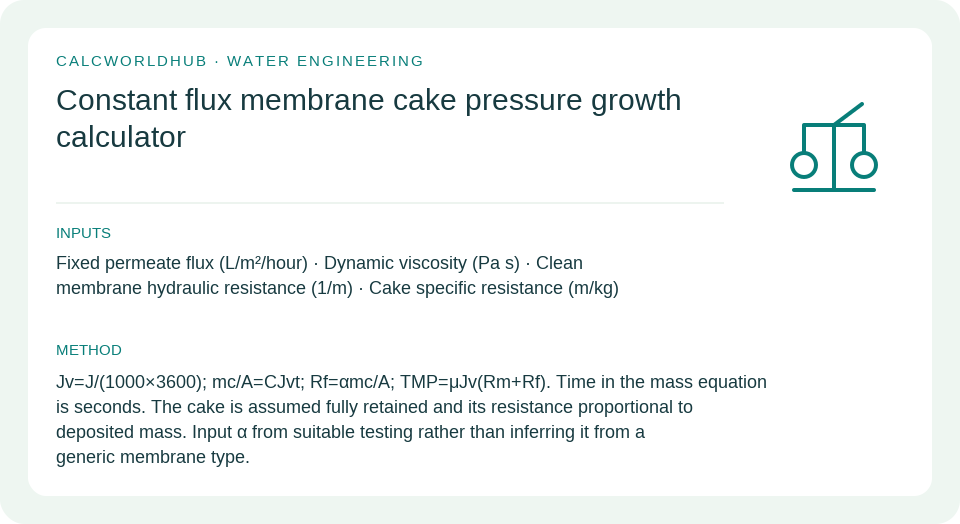
Jv=J/(1000×3600); mc/A=CJvt; Rf=αmc/A; TMP=μJv(Rm+Rf). Time in the mass equation is seconds.
The cake is assumed fully retained and its resistance proportional to deposited mass. Input α from suitable testing rather than inferring it from a generic membrane type.
What to enter
J— Fixed permeate flux (L/m²/hour)- Water volume rate per membrane area, held constant during filtration.
mu— Dynamic viscosity (Pa s)- Fluid viscosity used in the resistance-pressure relation.
Rm— Clean membrane hydraulic resistance (1/m)- Intrinsic resistance before cake accumulation.
alpha— Cake specific resistance (m/kg)- Constant resistance per deposited dry mass per membrane area.
C— Retained feed solids concentration (kg/m³)- Solids captured per volume of filtrate in the dilute complete-retention approximation.
t— Filtration duration (hours)- Uninterrupted constant-flux run time since the clean initial state.
Interpreting the result
Incompressible cake, constant viscosity and full solids retention; no backwash, concentration polarization, pore blocking, osmotic pressure or cake compression. Educational model; this is not a code-compliant design check.
Reading the outputs
Pressure is kPa, cake resistance is m⁻¹, resistance share is percent and deposit mass is kg/m².
Frequently asked questions
Does pressure remain constant in this model?
No. Flux is the controlled quantity and pressure rises as the cake resistance grows.
Can the cake be treated as compressible?
A pressure-dependent specific resistance would require a different nonlinear model.
Why is zero time useful?
It exposes the clean membrane baseline pressure before any cake is deposited.
How do I use the Constant flux membrane cake pressure growth calculator?
Enter Fixed permeate flux (L/m²/hour), Dynamic viscosity (Pa s), Clean membrane hydraulic resistance (1/m), Cake specific resistance (m/kg), then complete the remaining labeled fields. Match the units shown beside each field and review the result together with the assumptions below.
What is a worked example of Constant flux membrane cake pressure growth?
Fixed permeate flux (L/m²/hour) = 50; Dynamic viscosity (Pa s) = 0.001; Clean membrane hydraulic resistance (1/m) = 1.00000000e+12; Cake specific resistance (m/kg) = 5.00000000e+13; Retained feed solids concentration (kg/m³) = 0.05; Filtration duration (hours) = 4. Required transmembrane pressure: 20.833333 kPa Cake hydraulic resistance: 500000000000 1/m Cake share of total resistance: 33.333333 % Deposited cake mass per membrane area: 0.01 kg/m² At 50 L/m²/h for four hours, a feed carrying 0.05 kg/m³ retained solids deposits 0.01 kg/m². With α=5×10¹³ m/kg this adds 5×10¹¹ m⁻¹ resistance.
Background or definition reference: EPA Membrane Filtration Guidance Manual, hydraulic resistances.
Read our calculation methodology.