Microbial generation time calculator
Use the elapsed interval and two population counts to infer doubling time under constant exponential growth; both counts must be positive.
inputs.
Related calculators and articles
Compare methods and explore more free tools in biology.
How to use this calculator
Free Microbial generation time calculator. Estimate generation time from a positive exponential growth rate. Review the formula and assumptions.
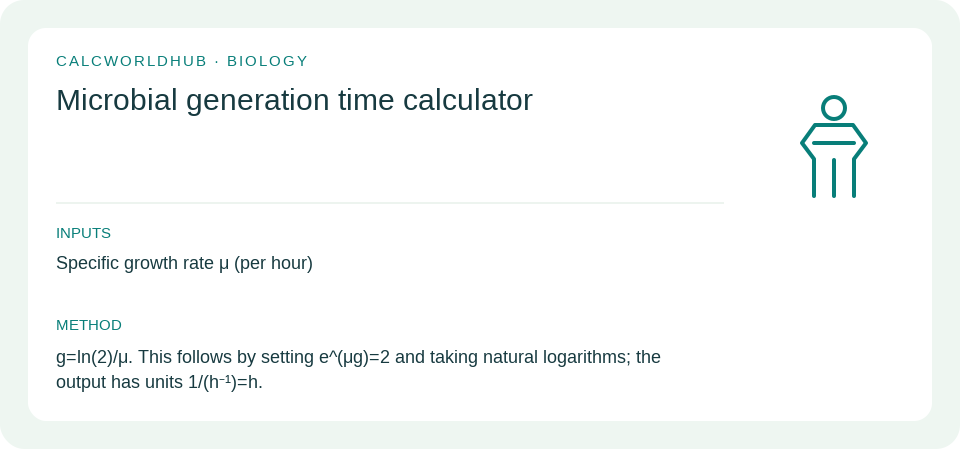
- Enter Specific growth rate μ (per hour). Match the units shown beside each field and review the result together with the assumptions below.
- Read the worked example below to check the expected input format and result.
- Compare another scenario by changing one input at a time. Use Reset to return to the starting values.
Microbial generation time
For a population growing exponentially at a constant specific growth rate μ, this calculator estimates the time required to double the population.
What the result represents
When N(t)=N₀e^(μt), doubling means N(t)/N₀=2. Solving gives g=ln(2)/μ. The rate and time units must be reciprocal: μ in h⁻¹ produces g in hours.
Inputs and units
a— Specific growth rate μ (per hour)- Enter the natural-log specific growth rate in h⁻¹, not a percentage. A rate of 0.35 h⁻¹ describes ln(population) increasing by 0.35 per hour during exponential growth.
Formula and method
g=ln(2)/μ. This follows by setting e^(μg)=2 and taking natural logarithms; the output has units 1/(h⁻¹)=h.
Worked example
At μ=0.35 h⁻¹, g=ln(2)/0.35=1.9804 hours. Doubling μ to 0.70 h⁻¹ halves g to 0.9902 hours.
Interpreting the result
This is a doubling time in hours for the supplied exponential growth rate. Zero or negative net growth has no finite positive doubling time under this model.
Assumptions and limits
Assumes a constant positive rate over the interval. Lag, stationary and decline phases, changing temperature or nutrients, and population heterogeneity are not represented.
Frequently asked questions
What units should μ use?
Use the natural-log specific growth rate per hour (h⁻¹), not a percentage. A value of 0.35 h⁻¹ means ln(population) rises by 0.35 per hour during the fitted exponential phase.
What does generation time mean here?
It is the time required for the population to double under a constant exponential growth rate.
Does it include lag or stationary phases?
No. The single rate applies only to the exponential-growth interval; changing conditions or cell death need a separate model.
How do I use the Microbial generation time calculator?
Enter Specific growth rate μ (per hour). Match the units shown beside each field and review the result together with the assumptions below.
What is a worked example of Microbial generation time?
At μ=0.35 h⁻¹, g=ln(2)/0.35=1.9804 hours. Doubling μ to 0.70 h⁻¹ halves g to 0.9902 hours.
Background: OpenStax Microbiology, How Microbes Grow; exponential doubling-time relation: OpenStax Calculus Volume 2.