Midpoint rectangle integral estimate
Use one midpoint function value to form a signed-area rectangle.
Calculator
How to use this calculator
Estimate a definite integral from interval bounds and one function value at the midpoint.
- Enter Lower x bound a, Upper x bound b, Function value at midpoint f(m). Match the units shown beside each field and review the result together with the assumptions below.
- Read the worked example below to check the expected input format and result.
- Compare another scenario by changing one input at a time. Use Reset to return to the starting values.
Estimate a definite integral with one midpoint height
The midpoint rectangle rule uses one supplied function height at the center of an interval to estimate signed area across that interval.
Inputs and units
- Lower x bound a: Enter the start of the interval.
- Upper x bound b: Enter an upper bound greater than a.
- Function value at midpoint f(m): Enter the function value at m = (a + b)/2; this height determines the rectangle.
Formula and method
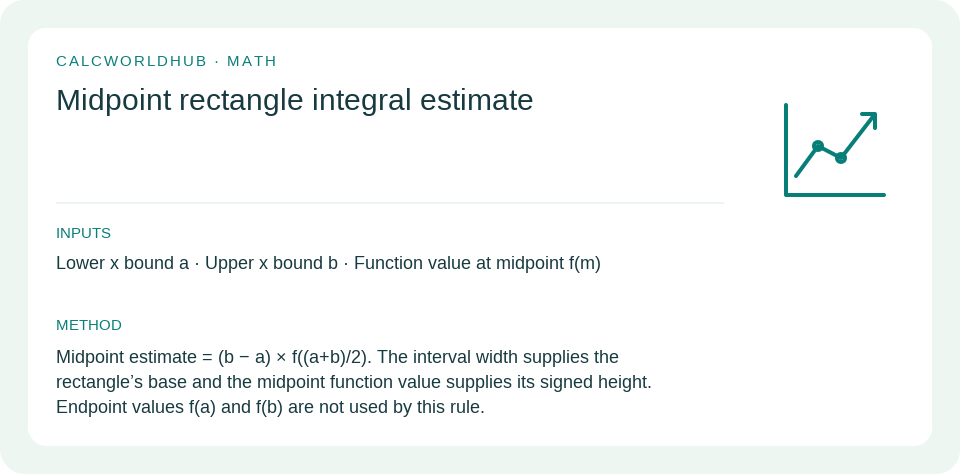
Midpoint estimate = (b − a) × f((a+b)/2). The interval width supplies the rectangle’s base and the midpoint function value supplies its signed height. Endpoint values f(a) and f(b) are not used by this rule.
Worked example
For a = 0, b = 2, and f(1) = 3, the rectangle has width 2 and height 3, so the estimate is 2 × 3 = 6 square units of x-by-function-value.
Interpreting the result
A positive height gives positive signed area; a negative height gives negative signed area. The approximation improves when the function is nearly flat or symmetric around the midpoint over the interval.
Assumptions and limits
One midpoint sample cannot reveal oscillations or sharp curvature inside the interval. This is a single-rectangle estimate, not an adaptive integration method or an error bound.
Frequently asked questions
Why are endpoint values not requested?
The single midpoint rectangle uses only the interval width and the midpoint height; endpoint samples do not enter this formula.
Can the estimate be negative?
Yes. A negative midpoint function value produces negative signed area under this rule.
How do I use the Midpoint rectangle integral estimate?
Enter Lower x bound a, Upper x bound b, Function value at midpoint f(m). Match the units shown beside each field and review the result together with the assumptions below.
What is a worked example of Midpoint rectangle integral estimate?
For a = 0, b = 2, and f(1) = 3, the rectangle has width 2 and height 3, so the estimate is 2 × 3 = 6 square units of x-by-function-value.
What does the Midpoint rectangle integral estimate calculate?
Estimate a definite integral from interval bounds and one function value at the midpoint.
Good calculators show their work.
CalcWorldHub is built around clear inputs and visible assumptions. Results are estimates for planning; check official sources or your provider’s terms when exact figures matter.