Single trapezoid integral estimate
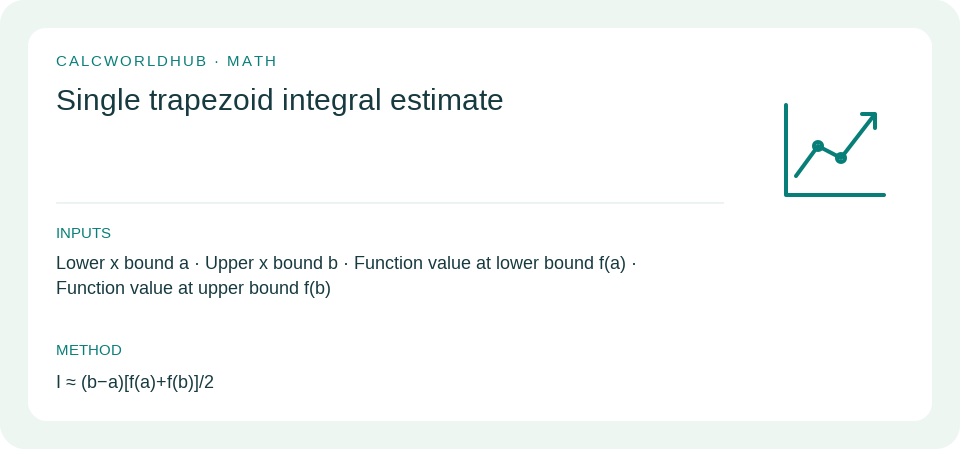
Approximate a definite integral by joining its two endpoint samples with a straight line.
Calculator
How to use this calculator
Approximate a definite integral by joining its two endpoint samples with a straight line.
- Enter Lower x bound a, Upper x bound b, Function value at lower bound f(a), Function value at upper bound f(b). Match the units shown beside each field and review the result together with the assumptions below.
- Read the worked example below to check the expected input format and result.
- Compare another scenario by changing one input at a time. Use Reset to return to the starting values.
Single trapezoid integral estimate
Approximate a definite integral by joining its two endpoint samples with a straight line.
Inputs and units
- Lower x bound a: Endpoint on the integration x-axis; x units multiply the function-output units to give integral units.
- Upper x bound b: Endpoint on the integration x-axis; x units multiply the function-output units to give integral units.
- Function value at lower bound f(a): Evaluate the same function at the matching x estimate; these outputs must be on one consistent function scale and must differ for a finite secant step.
- Function value at upper bound f(b): Evaluate the same function at the matching x estimate; these outputs must be on one consistent function scale and must differ for a finite secant step.
Formula and method
I ≈ (b−a)[f(a)+f(b)]/2
Worked example
For a=0, b=2 with f(a)=1 and f(b)=5, I≈2(1+5)/2=6.
Interpreting the result
The result is signed area under the linear endpoint approximation, not an exact integral unless the function is linear on the interval.
Assumptions and limits
Inputs must be finite and the upper bound must exceed the lower bound; output units combine x units with function-value units.
Sources and method
- Explains iterative root-finding, the role of starting estimates, and why convergence is not guaranteed; the secant update is independently checked from its two-point slope. OpenStax Calculus Volume 1: Newton’s method
Frequently asked questions
Which inputs determine this result?
The visible inputs are Lower x bound a, Upper x bound b, Function value at lower bound f(a), Function value at upper bound f(b). Each is used by the displayed formula; the calculator does not use any other hidden measurement.
When does this method apply?
Inputs must be finite and the upper bound must exceed the lower bound; output units combine x units with function-value units.
How do I use the Single trapezoid integral estimate?
Enter Lower x bound a, Upper x bound b, Function value at lower bound f(a), Function value at upper bound f(b). Match the units shown beside each field and review the result together with the assumptions below.
What is a worked example of Single trapezoid integral estimate?
For a=0, b=2 with f(a)=1 and f(b)=5, I≈2(1+5)/2=6.
What does the Single trapezoid integral estimate calculate?
Approximate a definite integral by joining its two endpoint samples with a straight line.
See the calculation methodology.
Good calculators show their work.
CalcWorldHub is built around clear inputs and visible assumptions. Results are estimates for planning; check official sources or your provider’s terms when exact figures matter.