How to use this calculator
Calculate the ideal nonwashout equilibrium or identify washout in a substrate-limited continuous culture.
- Enter Dilution rate (1/hour), Maximum specific growth rate (1/hour), Monod half-saturation concentration (g/L), Feed substrate concentration (g/L), then complete the remaining labeled fields. Match the units shown beside each field and review the result together with the assumptions below.
- Read the worked example below to check the expected input format and result.
- Compare another scenario by changing one input at a time. Use Reset to return to the starting values.
Monod chemostat steady state and washout explained
A continuous culture can retain biomass only while the substrate-limited growth rate can match dilution. This page distinguishes the nonwashout equilibrium from washout and reports both substrate and biomass at steady state.
Inputs, symbols, and units
d— Dilution rate (1/hour)- Dilution rate (1/hour).
mu— Maximum specific growth rate (1/hour)- Maximum specific growth rate (1/hour).
ks— Monod half-saturation concentration (g/L)- Monod half-saturation concentration (g/L).
feed— Feed substrate concentration (g/L)- Feed substrate concentration (g/L).
y— Biomass yield (g biomass/g substrate)- Biomass yield (g biomass/g substrate).
Formula and method
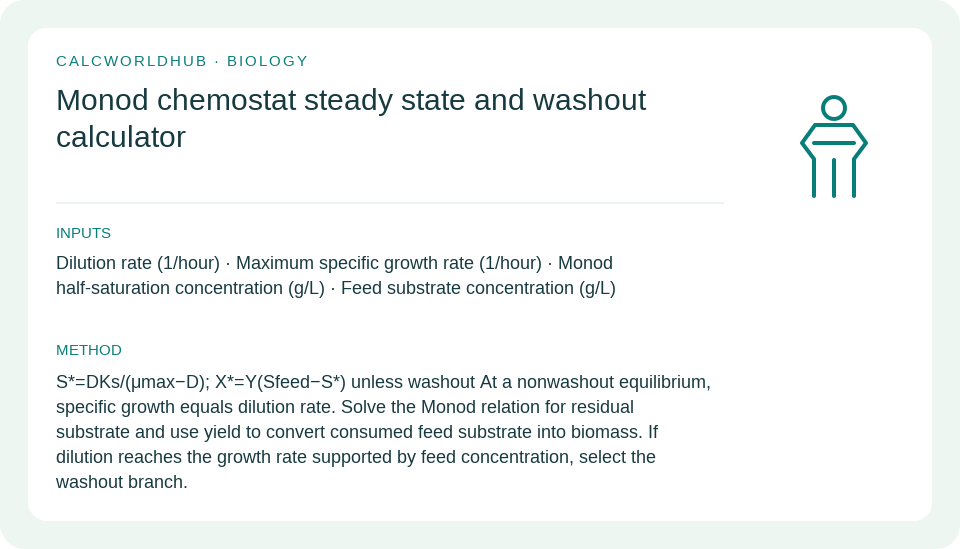
S*=DKs/(μmax−D); X*=Y(Sfeed−S*) unless washout
At a nonwashout equilibrium, specific growth equals dilution rate. Solve the Monod relation for residual substrate and use yield to convert consumed feed substrate into biomass. If dilution reaches the growth rate supported by feed concentration, select the washout branch.
A worked scenario
Dilution rate (1/hour) = 0.2; Maximum specific growth rate (1/hour) = 0.5; Monod half-saturation concentration (g/L) = 0.1; Feed substrate concentration (g/L) = 10; Biomass yield (g biomass/g substrate) = 0.5.
- Steady-state biomass: 4.96666667 g/L
- Residual substrate: 0.06666667 g/L
- Branch: Nonwashout equilibrium
This scenario uses the stated units and assumptions. Displayed values are rounded only after calculation.
Assumptions and edge cases
No decay, maintenance demand, inhibition, or feed biomass. At exactly zero dilution, the nonwashout branch is a limiting long-time model rather than a flowing chemostat.
Frequently asked questions
What sets the washout threshold?
The growth rate supported by feed substrate, not simply mu-max alone.
Does biomass decay appear?
No.
Can this predict transient recovery?
No, it is a steady-state model.
How do I use the Monod chemostat steady state and washout calculator?
Enter Dilution rate (1/hour), Maximum specific growth rate (1/hour), Monod half-saturation concentration (g/L), Feed substrate concentration (g/L), then complete the remaining labeled fields. Match the units shown beside each field and review the result together with the assumptions below.
What is a worked example of Monod chemostat steady state and washout?
Dilution rate (1/hour) = 0.2; Maximum specific growth rate (1/hour) = 0.5; Monod half-saturation concentration (g/L) = 0.1; Feed substrate concentration (g/L) = 10; Biomass yield (g biomass/g substrate) = 0.5. Steady-state biomass: 4.96666667 g/L Residual substrate: 0.06666667 g/L Branch: Nonwashout equilibrium This scenario uses the stated units and assumptions. Displayed values are rounded only after calculation.
Read our calculation methodology.