How to use this calculator
Compute overall first-order conversion through a series of ideal well-mixed flow reactors.
- Enter Well-mixed reactor volumes (L), Constant volume flow (L/min), First-order rate constant (1/min). Match the units shown beside each field and review the result together with the assumptions below.
- Read the worked example below to check the expected input format and result.
- Compare another scenario by changing one input at a time. Use Reset to return to the starting values.
First order CSTR cascade conversion explained
For reactors in series, each stage leaves fraction 1/(1+kVᵢ/Q) of its incoming concentration; multiply stage retention fractions to obtain total conversion.
A numerical walkthrough
Well-mixed reactor volumes (L) = 10, 10; Constant volume flow (L/min) = 2; First-order rate constant (1/min) = 0.1.
- Overall cascade conversion: 0.55555556
- Total nominal residence time: 10 min
Each 10 L reactor at 2 L/min has a five-minute nominal residence time. Each retains 1/(1+0.1×5)=2/3 of incoming reactant, so two stages retain 4/9 and convert 5/9.
The model behind the numbers
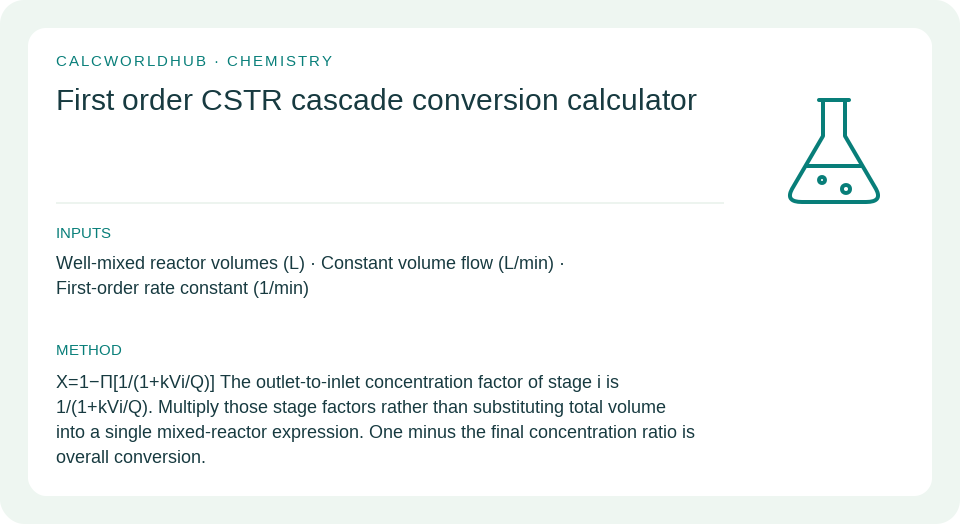
X=1−Π[1/(1+kVi/Q)]
The outlet-to-inlet concentration factor of stage i is 1/(1+kVi/Q). Multiply those stage factors rather than substituting total volume into a single mixed-reactor expression. One minus the final concentration ratio is overall conversion.
What to enter
v— Well-mixed reactor volumes (L)- Working volume of each ideal mixed tank in series; list order follows the flow path. A zero-volume stage has no concentration effect.
q— Constant volume flow (L/min)- Throughput shared by every stage; use one consistent volumetric-flow rate for the residence-time terms Vᵢ/Q.
k— First-order rate constant (1/min)- First-order reactant disappearance constant applied to each stage; k=0 gives zero conversion in the model.
Interpreting the result
Constant density, rate constant, and volumetric flow; no bypass, recycle, heat effects, or reversible chemistry.
Frequently asked questions
Does one big CSTR equal several smaller CSTRs?
Not generally; staging changes conversion.
Are residence times added before applying one CSTR formula?
No, each stage has its own concentration drop.
Can a zero-volume stage be entered?
Yes, it has no effect.
How do I use the First order CSTR cascade conversion calculator?
Enter Well-mixed reactor volumes (L), Constant volume flow (L/min), First-order rate constant (1/min). Match the units shown beside each field and review the result together with the assumptions below.
What is a worked example of First order CSTR cascade conversion?
Well-mixed reactor volumes (L) = 10, 10; Constant volume flow (L/min) = 2; First-order rate constant (1/min) = 0.1. Overall cascade conversion: 0.55555556 Total nominal residence time: 10 min Each 10 L reactor at 2 L/min has a five-minute nominal residence time. Each retains 1/(1+0.1×5)=2/3 of incoming reactant, so two stages retain 4/9 and convert 5/9.
Method reference: University of Michigan reaction-engineering design notes.
Read our calculation methodology.