How to use this calculator
Partition consumed reactant between two irreversible competing first-order pathways.
- Enter Initial reactant concentration (mol/L), Desired-product rate constant (1/min), Side-product rate constant (1/min), Reaction time (min). Match the units shown beside each field and review the result together with the assumptions below.
- Read the worked example below to check the expected input format and result.
- Compare another scenario by changing one input at a time. Use Reset to return to the starting values.
Competing first order product yields explained
How the calculation works
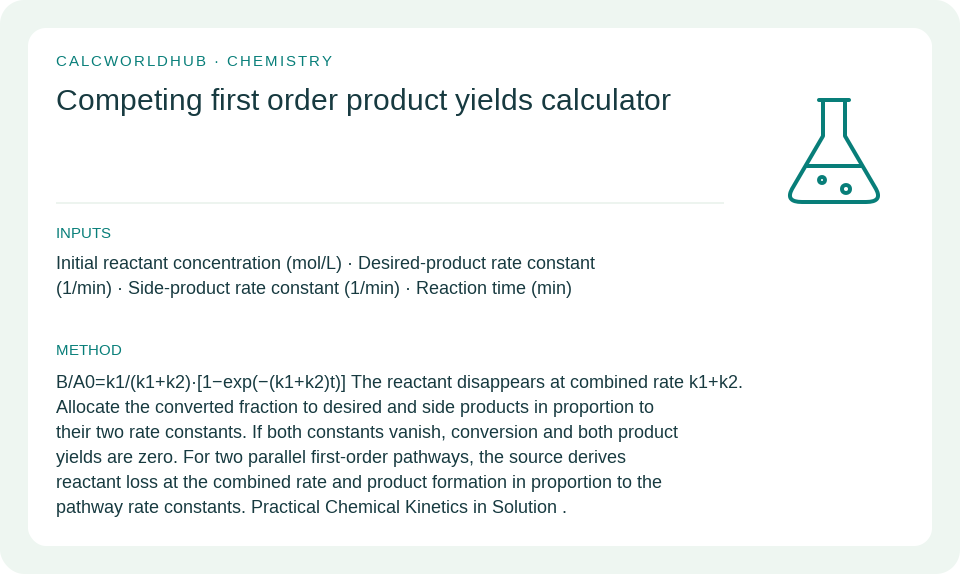
B/A0=k1/(k1+k2)·[1−exp(−(k1+k2)t)]
The reactant disappears at combined rate k1+k2. Allocate the converted fraction to desired and side products in proportion to their two rate constants. If both constants vanish, conversion and both product yields are zero.
For two parallel first-order pathways, the source derives reactant loss at the combined rate and product formation in proportion to the pathway rate constants. Practical Chemical Kinetics in Solution.
Set up the calculation
a— Initial reactant concentration (mol/L)- Initial reactant concentration shared by both competing pathways.
k1— Desired-product rate constant (1/min)- First-order rate constant for formation of the desired product.
k2— Side-product rate constant (1/min)- First-order rate constant for formation of the side product.
t— Reaction time (min)- Elapsed reaction time in minutes; both pathways act during this same interval.
Limits of this model
Both pathways consume one reactant unit and form one product unit; no secondary product reactions, reversibility, or changing rate constants.
Check this example
Initial reactant concentration (mol/L) = 1; Desired-product rate constant (1/min) = 0.2; Side-product rate constant (1/min) = 0.1; Reaction time (min) = 5.
- Desired product yield relative to initial reactant: 0.51791323
- Side product yield: 0.25895661
- Reactant remaining: 0.22313016 mol/L
Interpreting the result
The desired and side yields are fractions of the initial reactant, and together with unreacted material they account for the starting concentration. For fixed first-order rate constants, time changes total conversion but not the split between the two products.
Frequently asked questions
Can total conversion exceed desired yield?
Yes, some reactant forms the side product.
Does longer reaction time change the B:C selectivity here?
No, constant first-order competition fixes their ratio.
What if both rates are zero?
Nothing reacts.
How do I use the Competing first order product yields calculator?
Enter Initial reactant concentration (mol/L), Desired-product rate constant (1/min), Side-product rate constant (1/min), Reaction time (min). Match the units shown beside each field and review the result together with the assumptions below.
What is a worked example of Competing first order product yields?
Initial reactant concentration (mol/L) = 1; Desired-product rate constant (1/min) = 0.2; Side-product rate constant (1/min) = 0.1; Reaction time (min) = 5. Desired product yield relative to initial reactant: 0.51791323 Side product yield: 0.25895661 Reactant remaining: 0.22313016 mol/L
Read our calculation methodology.