How to use this calculator
Estimate monoprotic buffer capacity per pH unit from total concentration, acid dissociation constant, pH, and water equilibrium.
- Complete the labeled inputs for Monoprotic buffer capacity. Use the units requested by each field, then read the displayed result alongside the method and limits below.
- Read the worked example below to check the expected input format and result.
- Compare another scenario by changing one input at a time. Use Reset to return to the starting values.
Buffer capacity is a local resistance to pH change
Formula and method
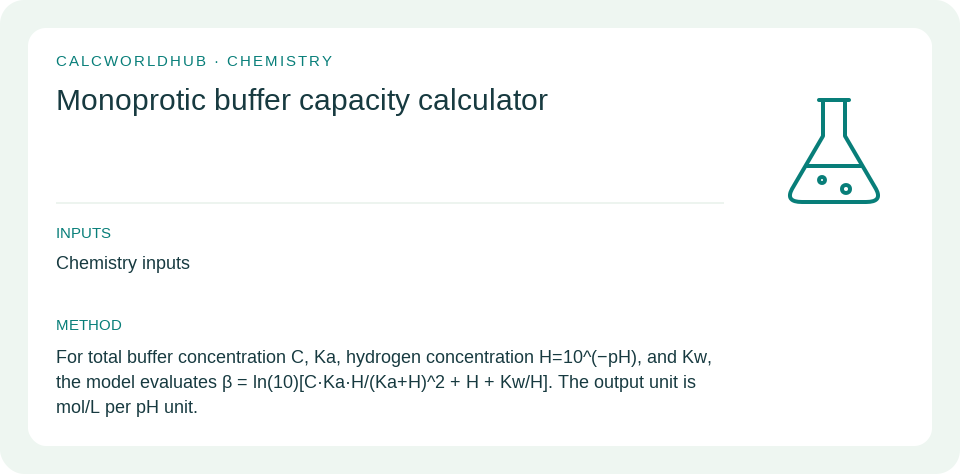
For total buffer concentration C, Ka, hydrogen concentration H=10^(−pH), and Kw, the model evaluates β = ln(10)[C·Ka·H/(Ka+H)^2 + H + Kw/H]. The output unit is mol/L per pH unit.
Worked example
Using C=0.10 mol/L, Ka=1.0×10⁻⁵, pH=5, and Kw=1.0×10⁻¹⁴, H=1.0×10⁻⁵ mol/L. Substitution into the displayed expression gives β≈0.0576 mol/L per pH unit.
Interpreting the result
A larger β means more strong acid or base is required for a small pH shift near the specified point. Capacity varies across the titration curve and is highest near the buffer’s effective pKa region.
Assumptions and limits
This expression assumes an idealized monoprotic system and concentration-based equilibrium constants. Activity effects, ionic strength, multiple acid-base systems, temperature, and volume changes can matter in real solutions.
Sources and method notes
Frequently asked questions
Near what pH is the acid contribution to buffer capacity greatest?
For this monoprotic model it peaks near pH = pKa, where acid and conjugate-base concentrations are comparable. Water contributions still depend on pH.
Is this capacity value an amount for the whole vessel?
No. The result is per liter per pH unit. Multiply by solution volume only for a local amount estimate, and do not treat it as constant over a large pH change.
How do I use the Monoprotic buffer capacity calculator?
Complete the labeled inputs for Monoprotic buffer capacity. Use the units requested by each field, then read the displayed result alongside the method and limits below.
What is a worked example of Monoprotic buffer capacity?
Using C=0.10 mol/L, Ka=1.0×10⁻⁵, pH=5, and Kw=1.0×10⁻¹⁴, H=1.0×10⁻⁵ mol/L. Substitution into the displayed expression gives β≈0.0576 mol/L per pH unit.
What does the Monoprotic buffer capacity calculator calculate?
Estimate monoprotic buffer capacity per pH unit from total concentration, acid dissociation constant, pH, and water equilibrium.
Read our calculation methodology.