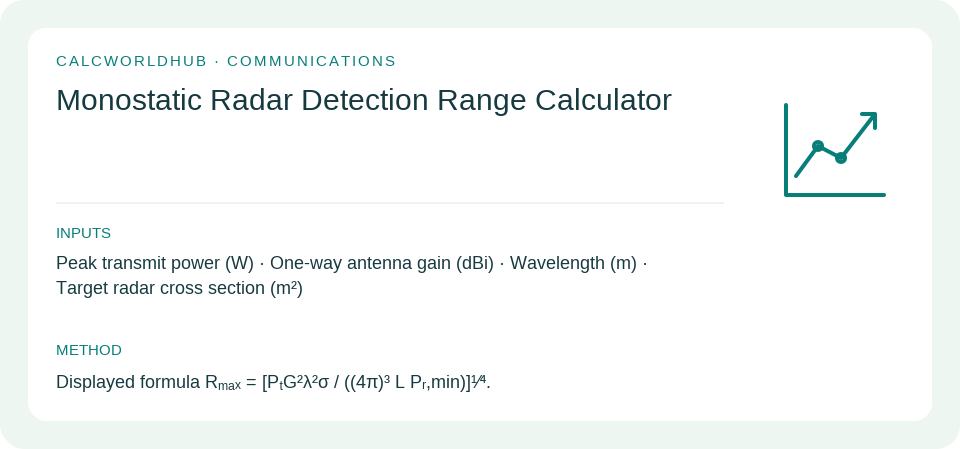
How to use this calculator
Estimate ideal monostatic radar range from transmitted power, antenna gain, wavelength, target cross section, and receiver threshold.
- Enter Peak transmit power (W), One-way antenna gain (dBi), Wavelength (m), Target radar cross section (m²), then complete the remaining labeled fields. Match the units shown beside each field and review the result together with the assumptions below.
- Read the worked example below to check the expected input format and result.
- Compare another scenario by changing one input at a time. Use Reset to return to the starting values.
How this calculation works
The monostatic radar equation relates the power returned from a target to transmitted power, antenna gain, wavelength, radar cross section, range, and system loss. Solving for range gives an idealized fourth-root estimate of the maximum distance at a stated minimum received-power threshold.
Inputs and units
transmitPowerW— Peak transmit power (W)- Peak power delivered to the transmitting antenna.
antennaGainDbi— One-way antenna gain (dBi)- Antenna gain relative to an isotropic radiator, used for both transmit and receive.
wavelengthM— Wavelength (m)- Free-space operating wavelength.
targetRcsM2— Target radar cross section (m²)- Radar cross section for the target aspect and frequency of interest.
minimumReceivedPowerW— Minimum received power (W)- Receiver’s minimum detectable returned power for this simplified calculation.
systemLossFactor— Linear system-loss factor, L- Dimensionless loss factor; use 1 for an ideal lossless system.
Formula
Rₘₐₓ = [PₜG²λ²σ / ((4π)³ L Pᵣ,min)]¹⁄⁴.
Method
Enter peak transmit power, one-way antenna gain in dBi, wavelength, target radar cross section, minimum received power, and a linear system-loss factor. The calculator converts dBi to linear gain and evaluates the free-space monostatic equation.
Worked example
With 1.00 kW peak power, 30 dBi gain, 3.00 cm wavelength, 1 m² target RCS, 1 pW minimum return, and L = 2, the ideal range is 3.881 km.
Assumptions and limits
This ideal single-target equation assumes the same antenna gain on transmit and receive and a free-space propagation model. It omits detection probability, noise integration, pulse compression, clutter, target fluctuation, atmospheric loss, terrain, and regulatory power limits.
Frequently asked questions
Why is the range a fourth root?
The monostatic returned power falls with the fourth power of range because the signal travels to the target and back.
What does the linear system-loss factor mean?
It collects specified losses as a multiplier greater than or equal to one in the received-power denominator.
Is this a reliable real-world detection guarantee?
No. Actual detection also depends on noise, integration, target fluctuation, clutter, propagation, and the required probability of detection.
How do I use the Monostatic Radar Detection Range Calculator?
Enter Peak transmit power (W), One-way antenna gain (dBi), Wavelength (m), Target radar cross section (m²), then complete the remaining labeled fields. Match the units shown beside each field and review the result together with the assumptions below.
What is a worked example of Monostatic Radar Detection Range?
With 1.00 kW peak power, 30 dBi gain, 3.00 cm wavelength, 1 m² target RCS, 1 pW minimum return, and L = 2, the ideal range is 3.881 km.
Reference: MathWorks Radar Equation point-target monostatic range relation. See our calculation methodology.