How to use this calculator
Reconcile an opening MRR balance to ending MRR using new, expansion, contraction, and churn movements.
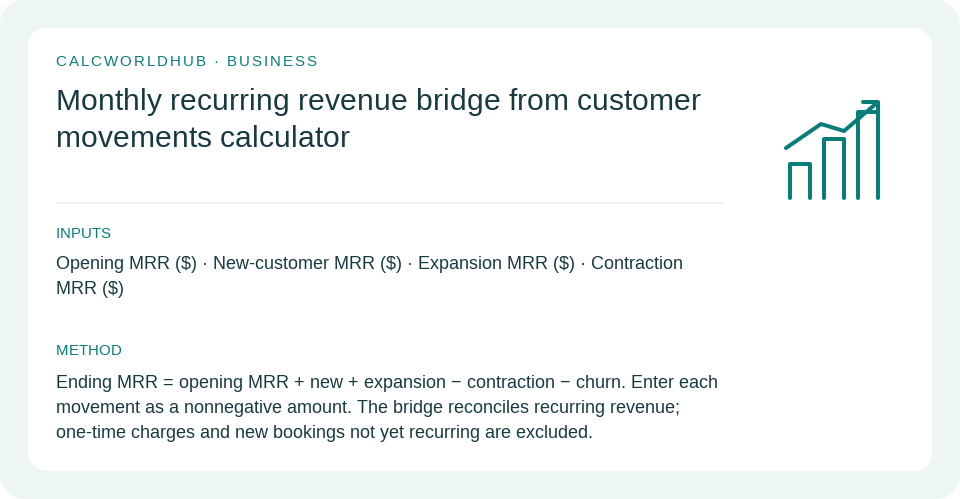
- Enter Opening MRR ($), New-customer MRR ($), Expansion MRR ($), Contraction MRR ($), then complete the remaining labeled fields. Match the units shown beside each field and review the result together with the assumptions below.
- Read the worked example below to check the expected input format and result.
- Compare another scenario by changing one input at a time. Use Reset to return to the starting values.
Monthly recurring revenue bridge from customer movements explained
An MRR bridge starts with the opening monthly recurring base, adds new-customer and expansion MRR, then subtracts contraction and churn. Keep the movements on the same month-end definition; exclude one-time fees and bookings that are not yet recurring.
Inputs, symbols, and units
opening— Opening MRR ($)- Recurring revenue at the start of the month.
new— New-customer MRR ($)- MRR from customers first added during the month.
expand— Expansion MRR ($)- Upsell and usage growth from existing customers.
contract— Contraction MRR ($)- Downgrade reduction from existing customers.
churn— Churned MRR ($)- Opening or in-period recurring revenue canceled during the month.
Formula and method
Ending MRR = opening MRR + new + expansion − contraction − churn.
Enter each movement as a nonnegative amount. The bridge reconciles recurring revenue; one-time charges and new bookings not yet recurring are excluded.
A worked scenario
Opening MRR ($) = 84000; New-customer MRR ($) = 9200; Expansion MRR ($) = 3400; Contraction MRR ($) = 1100; Churned MRR ($) = 2600.
- Ending MRR: 92900 $ / month
- Net new MRR: 8900 $ / month
- Gross MRR added: 12600 $ / month
An $84,000 opening balance plus $9,200 new and $3,400 expansion, less $1,100 contraction and $2,600 churn, ends at $92,900 MRR.
Assumptions and edge cases
Use one consistent month-end recognition convention. Reclassifying customer movements between categories changes the bridge detail, not the total.
Reading the outputs
The main result is ending MRR; supporting outputs are labeled with their own units. Use the units shown beside each input and result.
Frequently asked questions
What does the monthly recurring revenue bridge from customer movements calculate?
An $84,000 opening balance plus $9,200 new and $3,400 expansion, less $1,100 contraction and $2,600 churn, ends at $92,900 MRR.
Which inputs most affect ending mrr?
Enter each movement as a nonnegative amount. The bridge reconciles recurring revenue; one-time charges and new bookings not yet recurring are excluded.
Can this result replace a site-specific or measured value?
Use one consistent month-end recognition convention. Reclassifying customer movements between categories changes the bridge detail, not the total.
How do I use the Monthly recurring revenue bridge from customer movements calculator?
Enter Opening MRR ($), New-customer MRR ($), Expansion MRR ($), Contraction MRR ($), then complete the remaining labeled fields. Match the units shown beside each field and review the result together with the assumptions below.
What is a worked example of Monthly recurring revenue bridge from customer movements?
Opening MRR ($) = 84000; New-customer MRR ($) = 9200; Expansion MRR ($) = 3400; Contraction MRR ($) = 1100; Churned MRR ($) = 2600. Ending MRR: 92900 $ / month Net new MRR: 8900 $ / month Gross MRR added: 12600 $ / month An $84,000 opening balance plus $9,200 new and $3,400 expansion, less $1,100 contraction and $2,600 churn, ends at $92,900 MRR.
Read our calculation methodology.