Monthly ARPU calculator
Calculate monthly recurring revenue per customer. Enter your values below for a free estimate, with no account required.
Calculator

How to use this calculator
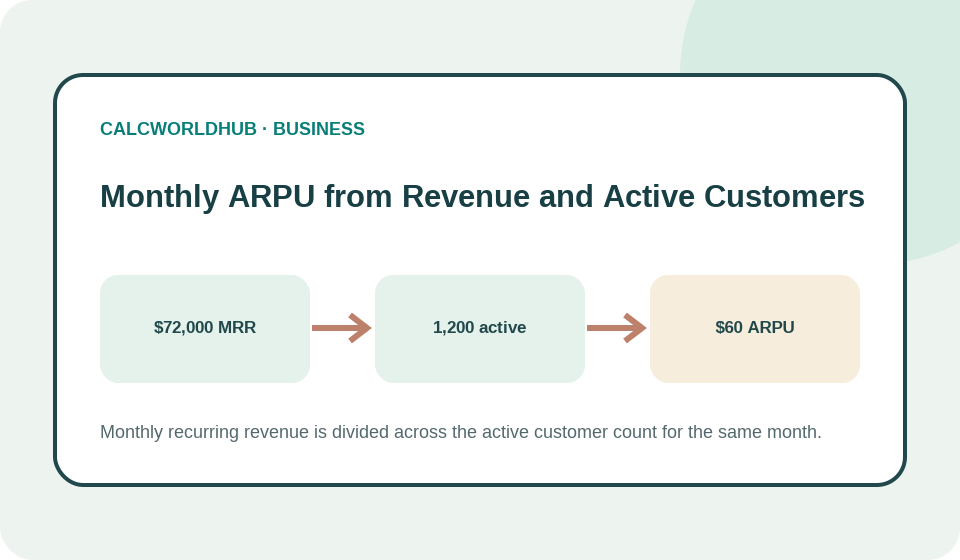
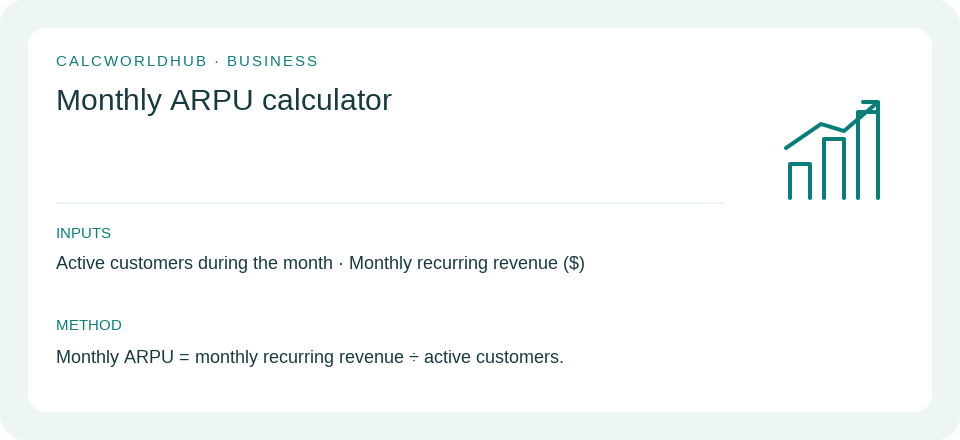
Divide monthly recurring revenue by the number of active customers during that same month.
- Enter Active customers during the month, Monthly recurring revenue ($). Match the units shown beside each field and review the result together with the assumptions below.
- Read the worked example below to check the expected input format and result.
- Compare another scenario by changing one input at a time. Use Reset to return to the starting values.
Calculate monthly revenue per active customer
Divide monthly recurring revenue by the number of active customers during that same month.
Inputs and units
- Active customers during the month
- Monthly recurring revenue ($)
Formula and method
Monthly ARPU = monthly recurring revenue ÷ active customers.
Worked example
$60,000 MRR ÷ 1,200 active customers = $50 per customer per month.
Interpreting the result
Use matching month boundaries and the same definition of active customer in numerator and denominator.
Assumptions and limits
This is an average, not a measure of median customer spend, profitability, or cohort retention.
Frequently asked questions
Should I include one-time sales in MRR?
No. Use recurring revenue for the period, consistent with the displayed metric.
How do I use the Monthly ARPU calculator?
Enter Active customers during the month, Monthly recurring revenue ($). Match the units shown beside each field and review the result together with the assumptions below.
What is a worked example of Monthly ARPU?
$60,000 MRR ÷ 1,200 active customers = $50 per customer per month.
What does the Monthly ARPU calculator calculate?
Divide monthly recurring revenue by the number of active customers during that same month.
What assumptions apply to Monthly ARPU?
This is an average, not a measure of median customer spend, profitability, or cohort retention.
Good calculators show their work.
CalcWorldHub is built around clear inputs and visible assumptions. Results are estimates for planning; check official sources or your provider’s terms when exact figures matter.