
Match numerator, denominator, and calendar period
For this calculator, monthly ARPU = monthly recurring revenue ÷ active customers during the month. Enter revenue in dollars and a customer count, not a customer percentage or a count from another month. If you use a different currency, convert consistently before comparing periods and label the currency; the arithmetic does not apply an exchange rate.
The denominator is a count of active customers for the month. Your own system must determine what “active” means—for example, at least one paid subscription or another recorded activity rule. If that rule changes, the series may change even when underlying customer behavior does not. Document whether trials, paused accounts, refunds, or non-paying users are included.
Interpret a mean as an average, not a typical invoice
ARPU compresses a distribution into one quotient. A small number of high-value accounts can raise the mean while most customers pay less. Conversely, many low-value accounts can lower it. The result does not show a median, a plan mix, a renewal rate, or the share of users who generated no revenue.
Revenue recognition and billing timing can also differ from cash collected in the month. The calculator uses the monthly recurring revenue value you enter; it does not reconcile invoices, discounts, credits, taxes, refunds, deferred revenue, or accounting policies. Use the same revenue definition in both the current period and the comparison period.
Use period-to-period comparisons with care
If monthly ARPU rises, the quotient increased; it does not identify the cause. A price change, a change in plan mix, expansion revenue, user-count definition, or unusually low activity could all move the number. Pair the average with customer counts and a revenue bridge before making a retention or pricing decision.
Compare matching months and business units. A partial month paired with a full-month customer count can depress the result. If the product has seasonal purchases, compare similar seasons or rolling periods rather than treating one month as a stable trend. Keep full precision for the division and round only the displayed currency amount.
Separate ARPU from nearby metrics
Average revenue per user and average order value answer different questions. ARPU uses a user or active-customer denominator over a period; average order value uses order count. Revenue per paying user narrows the denominator further to customers who paid. None of these measures is interchangeable with gross margin, contribution, lifetime value, or cash flow.
Platform analytics can define user activity in platform-specific ways. For example, analytics exports may distinguish active users from other user counts. Do not copy a platform’s label into a finance report without checking the underlying population and revenue basis. A well-defined label is part of the metric, not decoration.
Use monthly ARPU as a defined operating metric
For an internal dashboard, record the month, revenue basis, currency, active-customer rule, and treatment of credits next to the result. SEC guidance on key performance indicators recommends giving a clear definition and calculation for material metrics, along with why the measure is useful and how management uses it. That guidance is especially relevant when a company presents ARPU to investors.
The calculator is a quick quotient, not an accounting system or forecasting model. It cannot explain a change in customer mix, estimate future recurring revenue, or determine whether a cohort is profitable. Investigate the underlying revenue and customer records before treating a higher monthly average as evidence of better retention or business health.
Worked examples
The revenue and active-customer count below refer to the same month and the same population rule.
A larger base with recurring revenue
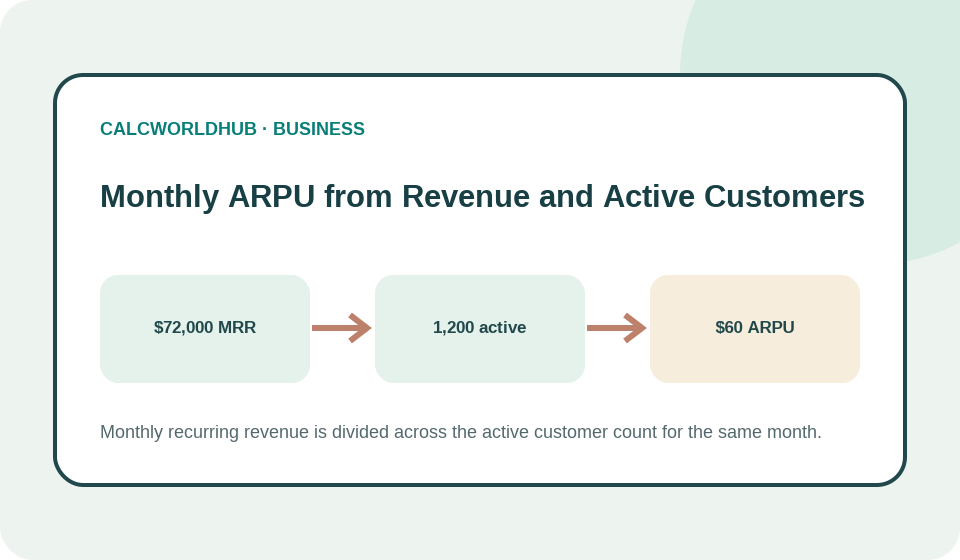
Inputs: Monthly recurring revenue = $72,000; active customers during the month = 1,200.
Calculation: Monthly ARPU = $72,000 ÷ 1,200 = $60.00 per active customer per month.
The period average is $60 per active customer; individual account charges may be above or below it.
A smaller month with the same revenue basis
Inputs: Monthly recurring revenue = $45,000; active customers during the month = 900.
Calculation: Monthly ARPU = $45,000 ÷ 900 = $50.00 per active customer per month.
The lower average reflects this month’s revenue-to-customer quotient; it does not identify why revenue or the customer mix differed.
