How to use this calculator
Combine separate rectangular pours into one concrete order and apply one shared allowance. Free calculator with formula, example, and assumptions.
- Enter Pour 1 length (ft), Pour 1 width (ft), Pour 1 thickness (in), Pour 2 length (ft), then complete the remaining labeled fields. Match the units shown beside each field and review the result together with the assumptions below.
- Read the worked example below to check the expected input format and result.
- Compare another scenario by changing one input at a time. Use Reset to return to the starting values.
How the estimate works
Estimate each rectangular pour in cubic feet, add the sections, and convert the combined volume to cubic yards before applying one material allowance. Separate pours can use different lengths, widths, and thicknesses.
Inputs and units
length1— Pour 1 length (ft)- Length of the first rectangular pour.
width1— Pour 1 width (ft)- Width of the first rectangular pour.
thickness1— Pour 1 thickness (in)- Thickness of the first pour.
length2— Pour 2 length (ft)- Length of the second rectangular pour.
width2— Pour 2 width (ft)- Width of the second pour.
thickness2— Pour 2 thickness (in)- Thickness of the second pour.
wastePct— Shared allowance (%)- Apply one allowance to the combined volume.
Formula and method
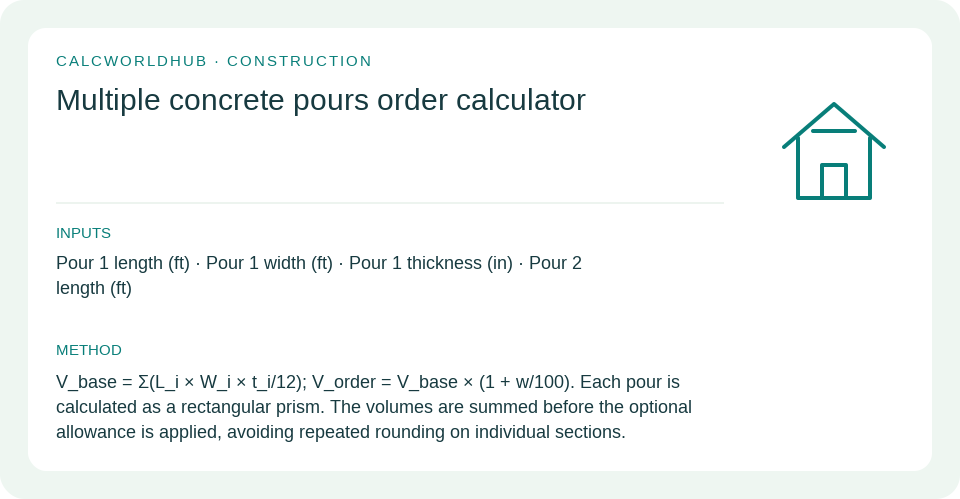
V_base = Σ(L_i × W_i × t_i/12); V_order = V_base × (1 + w/100).
Each pour is calculated as a rectangular prism. The volumes are summed before the optional allowance is applied, avoiding repeated rounding on individual sections.
Worked example
An 18×12 ft pour at 5 in is 90 ft³; a 10×8 ft pour at 4 in is 26.67 ft³. Combined 116.67 ft³ = 4.32 yd³; with 7% allowance, order about 4.62 yd³.
Assumptions and limits
Enter all dimensions in feet. Curved edges, slopes, steps, and embedded items are not deducted; split irregular pours into smaller prisms.
Frequently asked questions
Can I enter a missing second pour as zero?
Yes. A zero length or width makes that section contribute zero volume.
Why add the allowance after combining pours?
Applying it once to the sum keeps the order estimate consistent and avoids rounding each section separately.
Does it subtract drain openings?
No. Subtract large, known voids separately; small embedded items are commonly not deducted in rough takeoffs.
How do I use the Multiple concrete pours order calculator?
Enter Pour 1 length (ft), Pour 1 width (ft), Pour 1 thickness (in), Pour 2 length (ft), then complete the remaining labeled fields. Match the units shown beside each field and review the result together with the assumptions below.
What is a worked example of Multiple concrete pours order?
An 18×12 ft pour at 5 in is 90 ft³; a 10×8 ft pour at 4 in is 26.67 ft³. Combined 116.67 ft³ = 4.32 yd³; with 7% allowance, order about 4.62 yd³.
Read our calculation methodology.