How to use this calculator
Represent a power-of-two sample block with orthogonal square-wave patterns.
- Enter Uniform samples (signal units). Match the units shown beside each field and review the result together with the assumptions below.
- Read the worked example below to check the expected input format and result.
- Compare another scenario by changing one input at a time. Use Reset to return to the starting values.
Natural order Walsh Hadamard transform explained
This uses the normalized Sylvester Hadamard transform, whose coefficient order is natural rather than sequency-sorted.
How the calculation works
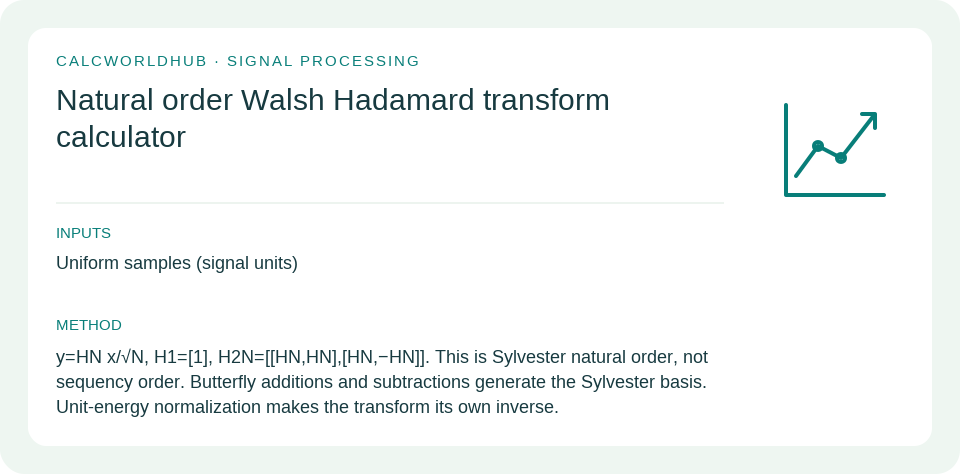
y=HN x/√N, H1=[1], H2N=[[HN,HN],[HN,−HN]]. This is Sylvester natural order, not sequency order.
Butterfly additions and subtractions generate the Sylvester basis. Unit-energy normalization makes the transform its own inverse.
Set up the calculation
x— Uniform samples (signal units)- Chronological real samples; use a comma-separated list in the same signal units. Use comma-separated values in the stated order.
Limits of this model
Power-of-two lengths only. Natural index order must not be interpreted as ordinary frequency or increasing sequency.
Check this example
Uniform samples (signal units) = [1, 2, 3, 4, 1, 2, 3, 4].
- Constant Walsh coefficient: 7.071068 signal units
- Walsh coefficient energy: 60 signal units²
- Natural-order coefficient 0: 7.071068 signal units
- Natural-order coefficient 1: -1.414214 signal units
- Natural-order coefficient 2: -2.828427 signal units
- Natural-order coefficient 3: 0 signal units
- Natural-order coefficient 4: 0 signal units
- Natural-order coefficient 5: 0 signal units
- Natural-order coefficient 6: 0 signal units
- Natural-order coefficient 7: 0 signal units
A repeating eight-sample ramp is transformed into natural-order coefficients, exposing its repeated block structure.
Reading the outputs
Every coefficient is in input units; energy matches the squared input norm.
Frequently asked questions
Is this a Fourier spectrum?
No. The basis consists of ±1 patterns rather than sinusoids.
Can I invert it using the same operation?
Yes, with this orthonormal Sylvester convention.
Why mention coefficient order?
Natural and sequency Walsh orders permute the same coefficient set.
How do I use the Natural order Walsh Hadamard transform calculator?
Enter Uniform samples (signal units). Match the units shown beside each field and review the result together with the assumptions below.
What is a worked example of Natural order Walsh Hadamard transform?
Uniform samples (signal units) = [1, 2, 3, 4, 1, 2, 3, 4]. Constant Walsh coefficient: 7.071068 signal units Walsh coefficient energy: 60 signal units² Natural-order coefficient 0: 7.071068 signal units Natural-order coefficient 1: -1.414214 signal units Natural-order coefficient 2: -2.828427 signal units Natural-order coefficient 3: 0 signal units Natural-order coefficient 4: 0 signal units Natural-order coefficient 5: 0 signal units Natural-order coefficient 6: 0 signal units Natural-order coefficient 7: 0 signal units A repeating eight-sample ramp is transformed into natural-order coefficients, exposing its repeated block structure.
Read our calculation methodology.