Negative binomial distribution variance calculator
Find the variance in failures observed before a fixed number of successes. Enter your values below to see the result and method.
inputs.
Related calculators
These tools cover nearby questions while keeping this page focused on its own calculation.
How to use this calculator
Find the variance in failures observed before a fixed number of successes.
- Enter Target successes r, Success probability p. Match the units shown beside each field and review the result together with the assumptions below.
- Read the worked example below to check the expected input format and result.
- Compare another scenario by changing one input at a time. Use Reset to return to the starting values.
Set the distribution and parameter convention
Find the variance in failures observed before a fixed number of successes.
Inputs and units
Use the units printed beside each field. These values are Target successes r, Success probability p.
- Target successes r: Fixed number of successes that ends the sequence of independent Bernoulli trials.
- Success probability p: Probability of success on each trial, held constant across trials; 0<p≤1.
Statistical formula and example
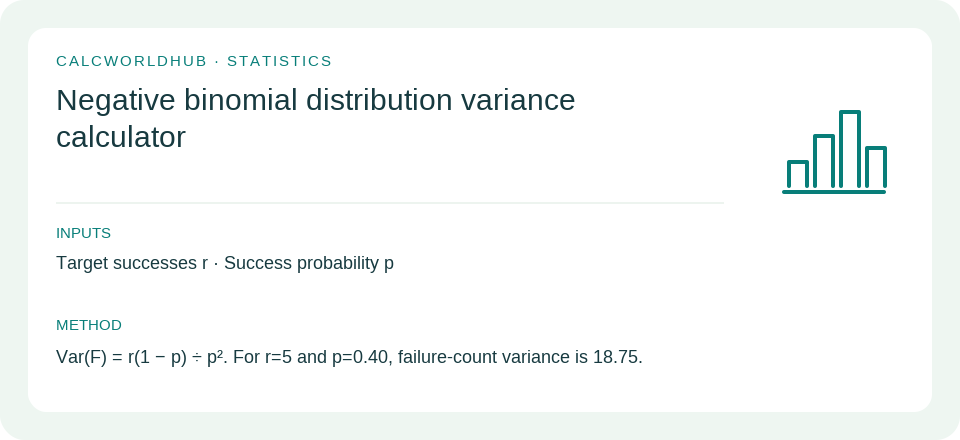
Var(F) = r(1 − p) ÷ p².
For r=5 and p=0.40, failure-count variance is 18.75.
Interpreting the statistic
This variance is for the number of failures before r successes under independent trials with constant p; it is in failures squared.
Assumptions and limitations
Uses the failures-before-r-successes parameterization; probabilities are constant and trials independent.
Method reference: Penn State STAT 414, The Negative Binomial Distribution.
Frequently asked questions
What does this distribution parameter mean?
It is the negative binomial distribution variance under the stated model. Inputs are Target successes r, Success probability p.
Can I apply this result to any dataset?
Only if the model assumptions fit the data. Uses the failures-before-r-successes parameterization; probabilities are constant and trials independent.
When is standard deviation easier to interpret than variance?
Standard deviation is the square root of this variance and returns to the count scale. Variance is useful in probability calculations that require a second moment.
How do I use the Negative binomial distribution variance calculator?
Enter Target successes r, Success probability p. Match the units shown beside each field and review the result together with the assumptions below.
What is a worked example of Negative binomial distribution variance?
Var(F) = r(1 − p) ÷ p². For r=5 and p=0.40, failure-count variance is 18.75.
Read the calculation methodology and privacy policy.