Negative-binomial standard deviation calculator
Measure failure-count spread before a fixed number of successes.
inputs.
Calculator
How to use this calculator
Calculate the standard deviation of failures before r successes using failure probability q.
- Enter Target successes r, Failure probability q (0–1). Match the units shown beside each field and review the result together with the assumptions below.
- Read the worked example below to check the expected input format and result.
- Compare another scenario by changing one input at a time. Use Reset to return to the starting values.
Measure spread in failures counted before a success target
Calculate the standard deviation for a negative-binomial count of failures before a fixed number of successes.
Inputs and units
- Target successes r: Positive whole number of successes in the count model.
- Failure probability q (0–1): Probability of failure on each independent trial; success probability is 1−q.
Formula and method
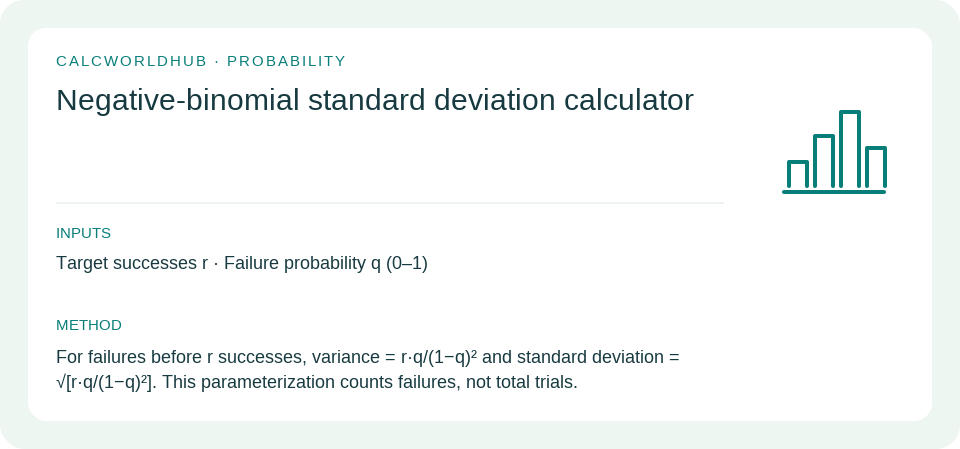
For failures before r successes, variance = r·q/(1−q)² and standard deviation = √[r·q/(1−q)²]. This parameterization counts failures, not total trials.
Worked example
With r=3 successes and failure probability q=0.4, SD = √(3×0.4/0.6²) = √3.3333 ≈ 1.82574 failures.
Interpreting the result
The standard deviation describes variability in the number of failures before the rth success under the stated independent-trial model.
Assumptions and limits
Assumes a fixed success probability on independent Bernoulli trials and q below 1. Other negative-binomial conventions may count total trials or use a success-probability parameter; confirm the parameterization.
Method references
Frequently asked questions
Why is q the failure probability?
This page counts failures before r successes; q denotes failure and 1−q denotes success.
Can the result be a fraction of a failure?
Yes. A standard deviation is a spread measure and need not be an integer count.
How do I use the Negative-binomial standard deviation calculator?
Enter Target successes r, Failure probability q (0–1). Match the units shown beside each field and review the result together with the assumptions below.
What is a worked example of Negative-binomial standard deviation?
With r=3 successes and failure probability q=0.4, SD = √(3×0.4/0.6²) = √3.3333 ≈ 1.82574 failures.
What does the Negative-binomial standard deviation calculator calculate?
Calculate the standard deviation of failures before r successes using failure probability q.
Good calculators show their work.
CalcWorldHub is built around clear inputs and visible assumptions. Results are estimates for planning; check official sources or your provider’s terms when exact figures matter.