How to use this calculator
Plan an NTC divider reading and estimate whether its excitation causes a meaningful temperature bias.
- Enter Resistance at reference temperature (ohm), Reference temperature (K), NTC beta constant (K), Ambient temperature (K), then complete the remaining labeled fields. Match the units shown beside each field and review the result together with the assumptions below.
- Read the worked example below to check the expected input format and result.
- Compare another scenario by changing one input at a time. Use Reset to return to the starting values.
NTC beta-model divider and self-heating explained
Plan an NTC divider reading and estimate whether its excitation causes a meaningful temperature bias.
How the calculation works
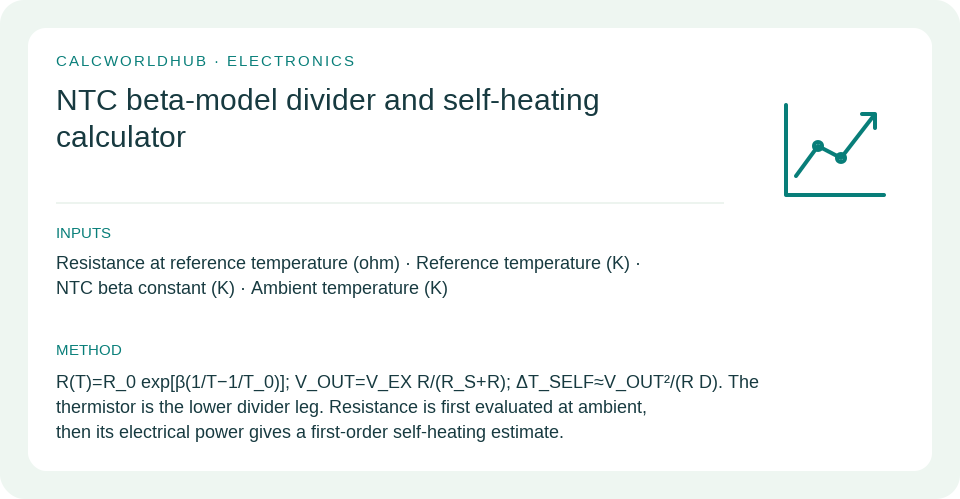
R(T)=R_0 exp[β(1/T−1/T_0)]; V_OUT=V_EX R/(R_S+R); ΔT_SELF≈V_OUT²/(R D).
The thermistor is the lower divider leg. Resistance is first evaluated at ambient, then its electrical power gives a first-order self-heating estimate.
Set up the calculation
R0— Resistance at reference temperature (ohm)- Thermistor nominal reference resistance.
T0— Reference temperature (K)- Absolute temperature associated with R0.
beta— NTC beta constant (K)- Beta coefficient over the intended temperature interval.
T— Ambient temperature (K)- Target absolute temperature before self-heating.
Rs— Series resistor (ohm)- Fixed resistor between supply and thermistor node.
V— Excitation voltage (V)- Voltage across the series resistor and thermistor.
D— Dissipation constant (W/K)- Heat dissipated per kelvin rise under installation conditions.
Limits of this model
Constant beta over the chosen range, no lead resistance or ADC loading. Extreme temperatures require manufacturer Steinhart-Hart data.
Check this example
Resistance at reference temperature (ohm) = 10000; Reference temperature (K) = 298.15; NTC beta constant (K) = 3950; Ambient temperature (K) = 323.15; Series resistor (ohm) = 10000; Excitation voltage (V) = 3.3; Dissipation constant (W/K) = 0.002.
- Divider output: 0.871419 V
- Ambient-model thermistor resistance: 3588.182582 ohm
- First-order self-heating rise: 0.105816 K
A 10 kohm, beta-3950 thermistor at 50 °C sits below a 10 kohm resistor on 3.3 V; its divider voltage falls below the 25 °C midscale value.
Reading the outputs
The self-heating rise is not fed back into the beta equation; a large rise indicates a need for coupled thermal iteration or lower excitation.
Frequently asked questions
Must temperature be in kelvin?
Yes; reciprocal temperature in the beta model must use an absolute scale.
Why does the output decrease when temperature rises?
An NTC resistance decreases, and this topology measures across the thermistor.
How can self-heating be reduced?
Reduce excitation, pulse the measurement or choose a more favorable divider current.
How do I use the NTC beta-model divider and self-heating calculator?
Enter Resistance at reference temperature (ohm), Reference temperature (K), NTC beta constant (K), Ambient temperature (K), then complete the remaining labeled fields. Match the units shown beside each field and review the result together with the assumptions below.
What is a worked example of NTC beta-model divider and self-heating?
Resistance at reference temperature (ohm) = 10000; Reference temperature (K) = 298.15; NTC beta constant (K) = 3950; Ambient temperature (K) = 323.15; Series resistor (ohm) = 10000; Excitation voltage (V) = 3.3; Dissipation constant (W/K) = 0.002. Divider output: 0.871419 V Ambient-model thermistor resistance: 3588.182582 ohm First-order self-heating rise: 0.105816 K A 10 kohm, beta-3950 thermistor at 50 °C sits below a 10 kohm resistor on 3.3 V; its divider voltage falls below the 25 °C midscale value.
Background or definition reference: Analog Devices thermistor measurement design.
Read our calculation methodology.