How to use this calculator
Free Number needed to treat calculator. Estimate how many people would need an intervention for one additional favorable outcome versus a comparator.
- Enter Control event rate (%), Treatment event rate (%). Match the units shown beside each field and review the result together with the assumptions below.
- Read the worked example below to check the expected input format and result.
- Compare another scenario by changing one input at a time. Use Reset to return to the starting values.
Translate a risk difference into people treated
The number needed to treat expresses an absolute event-rate difference as the number of people who would need the intervention for one additional outcome over the study’s stated follow-up. Direction depends on whether the event is beneficial or harmful.
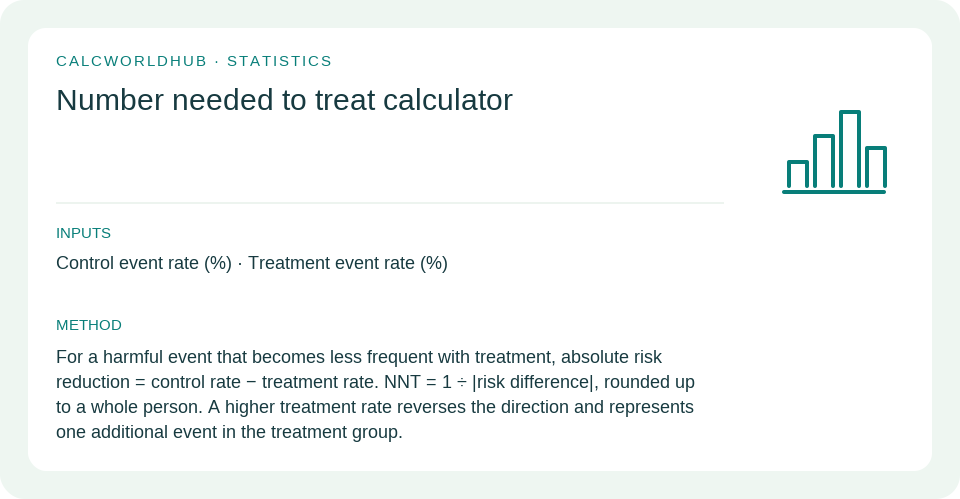
Inputs for this calculation
- Control event rate (%): The proportion with the chosen outcome in the comparator group.
- Treatment event rate (%): The proportion with the same outcome, measured over the same period, in the intervention group.
Formula and method
For a harmful event that becomes less frequent with treatment, absolute risk reduction = control rate − treatment rate. NNT = 1 ÷ |risk difference|, rounded up to a whole person. A higher treatment rate reverses the direction and represents one additional event in the treatment group.
Worked example
If an adverse event occurs in 20% of controls and 15% of the treatment group over the same follow-up, the absolute reduction is 5 percentage points (0.05). The reciprocal is 1 ÷ 0.05 = 20, so the estimate is 20 people treated to prevent one additional event.
Reading the result
NNT is tied to a particular outcome, comparator, population, and time horizon. A value of 20 does not mean every group of 20 will contain exactly one prevented event.
Assumptions and limits
The arithmetic describes an observed or assumed risk difference; it does not establish causality or account for uncertainty around that difference. Keep benefit and harm outcomes clearly labeled when reporting an NNT.
Method references
- Cochrane Handbook, Chapter 6: Choosing effect measures
- Cochrane Handbook, Chapter 15: Interpreting results
- Cochrane Statistical and mathematical presentation: NNT rounding
Frequently asked questions
Why is the NNT rounded up?
People are counted in whole numbers, so a fractional reciprocal is rounded upward to avoid understating how many would need treatment for one full additional outcome.
How do I use the Number needed to treat calculator?
Enter Control event rate (%), Treatment event rate (%). Match the units shown beside each field and review the result together with the assumptions below.
What is a worked example of Number needed to treat?
If an adverse event occurs in 20% of controls and 15% of the treatment group over the same follow-up, the absolute reduction is 5 percentage points (0.05). The reciprocal is 1 ÷ 0.05 = 20, so the estimate is 20 people treated to prevent one additional event.
What does the Number needed to treat calculator calculate?
Free Number needed to treat calculator. Estimate how many people would need an intervention for one additional favorable outcome versus a comparator.
What assumptions apply to Number needed to treat?
The arithmetic describes an observed or assumed risk difference; it does not establish causality or account for uncertainty around that difference. Keep benefit and harm outcomes clearly labeled when reporting an NNT. This example assumes the event is undesirable and less frequent in the treatment group.