How to use this calculator
Estimate the oedometer compression index from two void ratios and effective stresses on the virgin compression branch.
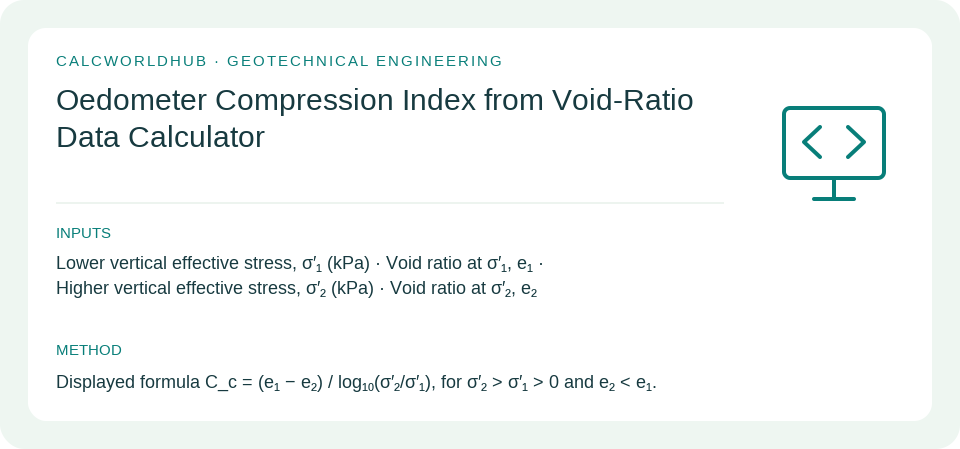
- Enter Lower vertical effective stress, σ′₁ (kPa), Void ratio at σ′₁, e₁, Higher vertical effective stress, σ′₂ (kPa), Void ratio at σ′₂, e₂. Match the units shown beside each field and review the result together with the assumptions below.
- Read the worked example below to check the expected input format and result.
- Compare another scenario by changing one input at a time. Use Reset to return to the starting values.
How this calculation works
Enter two effective vertical stresses and their corresponding void ratios from the approximately straight virgin compression portion of an oedometer e-log stress curve. The calculator returns the positive two-point secant compression index C_c.
Inputs and units
stress1Kpa— Lower vertical effective stress, σ′₁ (kPa)- Positive effective stress at the first point on the virgin compression branch.
voidRatio1— Void ratio at σ′₁, e₁- Void ratio measured at the lower effective stress.
stress2Kpa— Higher vertical effective stress, σ′₂ (kPa)- Effective stress at the second point; it must exceed σ′₁.
voidRatio2— Void ratio at σ′₂, e₂- Void ratio measured at the higher effective stress; it must be less than e₁ for compression.
Formula
C_c = (e₁ − e₂) / log₁₀(σ′₂/σ′₁), for σ′₂ > σ′₁ > 0 and e₂ < e₁.
Method
Find the decrease in void ratio between the two measured points and divide it by the base-10 logarithm of the effective-stress ratio. C_c is dimensionless and should be determined from points on the virgin compression branch.
Worked example
For e₁ = 0.80 at 100 kPa and e₂ = 0.62 at 400 kPa, C_c = (0.80 − 0.62)/log₁₀(400/100) = 0.2990.
Assumptions and limits
This is a two-point secant estimate, not a regression over a full oedometer curve. Select points within the linear virgin-compression range; do not mix recompression, unloading, swelling, or secondary-compression portions. The tool does not identify preconsolidation stress, validate test quality, or calculate settlement.
Frequently asked questions
Which curve segment should I use?
Use two points on the approximately straight virgin-compression branch of the oedometer void-ratio versus log effective-stress plot.
Is C_c dimensionless?
Yes. It is a change in void ratio per base-10 log cycle of effective stress.
Does this calculator estimate settlement?
No. It derives a two-point C_c value from measurements; settlement requires a separate stress-path and layer calculation.
How do I use the Oedometer Compression Index from Void-Ratio Data Calculator?
Enter Lower vertical effective stress, σ′₁ (kPa), Void ratio at σ′₁, e₁, Higher vertical effective stress, σ′₂ (kPa), Void ratio at σ′₂, e₂. Match the units shown beside each field and review the result together with the assumptions below.
What is a worked example of Oedometer Compression Index from Void-Ratio Data?
For e₁ = 0.80 at 100 kPa and e₂ = 0.62 at 400 kPa, C_c = (0.80 − 0.62)/log₁₀(400/100) = 0.2990.
Reference: FHWA GEC No. 5 oedometer compression-index definitions. See our calculation methodology.