How to use this calculator
Track a sharp freezing front when a semi-infinite material initially at its melting point contacts a colder fixed-temperature wall.
- Enter Phase-change temperature (°C), Fixed cold boundary temperature (°C), Frozen-phase heat capacity (J/kg/K), Latent heat (J/kg), then complete the remaining labeled fields. Match the units shown beside each field and review the result together with the assumptions below.
- Read the worked example below to check the expected input format and result.
- Compare another scenario by changing one input at a time. Use Reset to return to the starting values.
One phase Stefan freezing front similarity solution explained
Track a sharp freezing front when a semi-infinite material initially at its melting point contacts a colder fixed-temperature wall.
How the calculation works
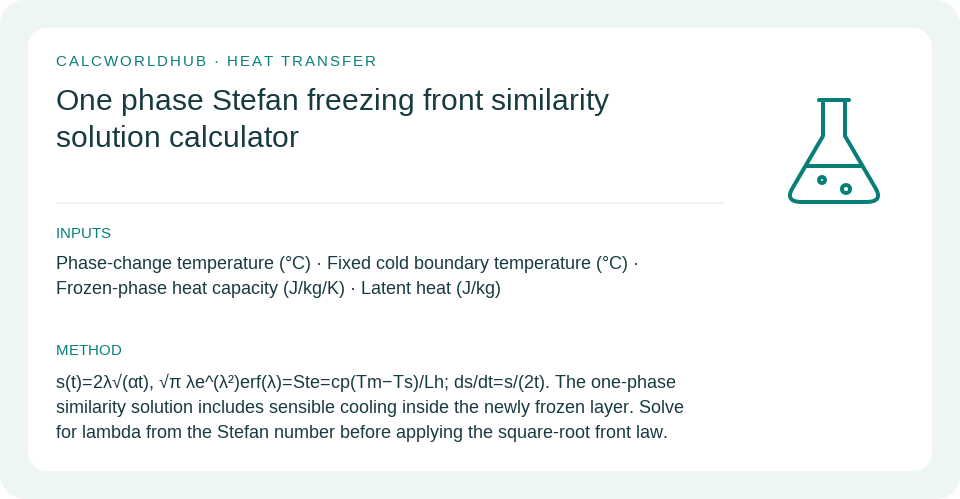
s(t)=2λ√(αt), √π λe^(λ²)erf(λ)=Ste=cp(Tm−Ts)/Lh; ds/dt=s/(2t).
The one-phase similarity solution includes sensible cooling inside the newly frozen layer. Solve for lambda from the Stefan number before applying the square-root front law.
Set up the calculation
Tm— Phase-change temperature (°C)- Material phase-change temperature. The boundary temperature Ts must be colder for a freezing front to advance.
Ts— Fixed cold boundary temperature (°C)- Fixed cold-side boundary temperature below Tm; the difference Tm−Ts drives sensible cooling of the frozen layer.
cp— Frozen-phase heat capacity (J/kg/K)- Specific heat of the frozen phase, used in the Stefan number for sensible heat relative to latent heat.
latent— Latent heat (J/kg)- Latent heat per unit mass released at the moving phase boundary.
alpha— Frozen-phase diffusivity (m²/s)- Thermal diffusivity of the frozen phase; it controls the √(αt) distance scale.
t— Time since freezing starts (s)- Positive elapsed time since freezing begins; the similarity front grows in proportion to its square root.
Limits of this model
One phase conducts, liquid stays at phase-change temperature, equal-density/no-flow approximation, constant properties and no mushy range or contact resistance.
Check this example
Phase-change temperature (°C) = 0; Fixed cold boundary temperature (°C) = -20; Frozen-phase heat capacity (J/kg/K) = 2100; Latent heat (J/kg) = 333500; Frozen-phase diffusivity (m²/s) = 0.000001; Time since freezing starts (s) = 3600.
- Frozen layer thickness: 0.031645 m
- Similarity front coefficient: 0.245908
- Stefan number: 0.125937
- Instantaneous front speed: 0.000004 m/s
Material at its 0 °C phase-change point contacts a −20 °C wall with cp=2,100 J/kg/K and latent heat 333,500 J/kg. After one hour, the ideal frozen layer is 0.0316448 m thick and advancing at 4.39511e−6 m/s; conduction through the growing layer slows the front.
Reading the outputs
Thickness and speed describe the moving interface; lambda and Stefan number are dimensionless.
Frequently asked questions
Why is this not just latent heat divided by cooling power?
The conducting frozen layer grows with time, so heat extraction and interface speed change continually.
Does this include initial liquid superheat?
No. The initial unfrozen material must be at the phase-change temperature.
Can a finite container use this indefinitely?
No. The remote boundary eventually alters the similarity solution.
How do I use the One phase Stefan freezing front similarity solution calculator?
Enter Phase-change temperature (°C), Fixed cold boundary temperature (°C), Frozen-phase heat capacity (J/kg/K), Latent heat (J/kg), then complete the remaining labeled fields. Match the units shown beside each field and review the result together with the assumptions below.
What is a worked example of One phase Stefan freezing front similarity solution?
Phase-change temperature (°C) = 0; Fixed cold boundary temperature (°C) = -20; Frozen-phase heat capacity (J/kg/K) = 2100; Latent heat (J/kg) = 333500; Frozen-phase diffusivity (m²/s) = 0.000001; Time since freezing starts (s) = 3600. Frozen layer thickness: 0.031645 m Similarity front coefficient: 0.245908 Stefan number: 0.125937 Instantaneous front speed: 0.000004 m/s Material at its 0 °C phase-change point contacts a −20 °C wall with cp=2,100 J/kg/K and latent heat 333,500 J/kg. After one hour, the ideal frozen layer is 0.0316448 m thick and advancing at 4.39511e−6 m/s; conduction through the growing layer slows the front.
Background or definition reference: IIT NPTEL heat-transfer phase-change course.
Read our calculation methodology.