One’s complement signed integer range calculator
Find the minimum and maximum signed values representable with a fixed number of one’s-complement bits. Enter your values below to see the result and method.
inputs.
Related calculators
These tools cover nearby questions while keeping this page focused on its own calculation.
How to use this calculator
Find the minimum and maximum signed values representable with a fixed number of one’s-complement bits.
- Enter Total bit width n. Match the units shown beside each field and review the result together with the assumptions below.
- Read the worked example below to check the expected input format and result.
- Compare another scenario by changing one input at a time. Use Reset to return to the starting values.
Define the system or input
Find the minimum and maximum signed values representable with a fixed number of one’s-complement bits.
Inputs and units
Use the units printed beside each field. This value is Total bit width n.
- Total bit width n: Total bit width n as defined for the physical or engineering situation.
Calculation method and example
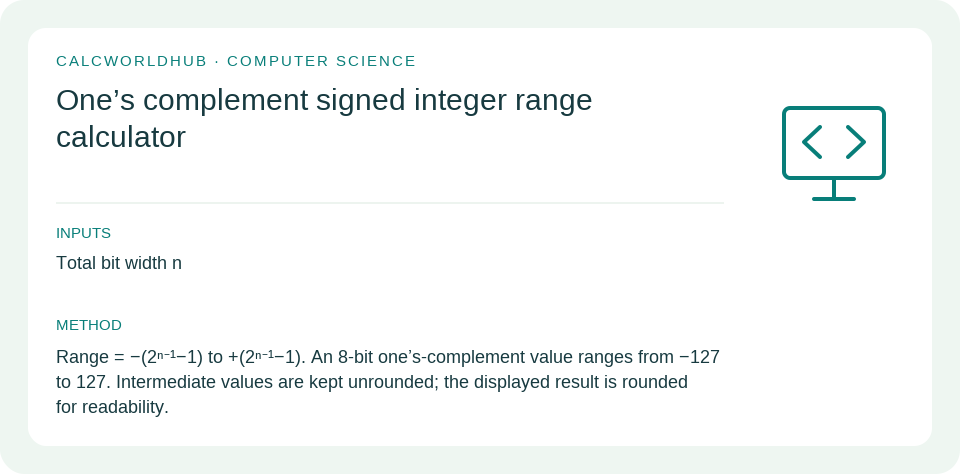
Range = −(2ⁿ⁻¹−1) to +(2ⁿ⁻¹−1).
An 8-bit one’s-complement value ranges from −127 to 127.
Intermediate values are kept unrounded; the displayed result is rounded for readability.
Interpreting the output
The minimum and maximum are symmetric because one’s complement reserves two bit patterns for zero. Increasing the bit width adds one bit to each side of that symmetric range.
Assumptions and limitations
Requires at least two bits; one’s complement has both positive and negative zero encodings.
Frequently asked questions
Why does one’s complement have two zero encodings?
The bitwise complement of positive zero is negative zero, so an n-bit representation has both +0 and −0. This leaves the symmetric range −(2^(n−1)−1) through +(2^(n−1)−1).
How does this range differ from two’s complement?
Two’s complement uses the otherwise missing negative endpoint, giving −2^(n−1) through 2^(n−1)−1 and only one zero encoding.
When is the two’s complement range more useful than the one’s complement signed integer range?
This page calculates: Find the minimum and maximum signed values representable with a fixed number of one’s-complement bits. The related calculator focuses on Two’s complement range calculator. Use that page if its named output is the quantity you need.
How do I use the One’s complement signed integer range calculator?
Enter Total bit width n. Match the units shown beside each field and review the result together with the assumptions below.
What is a worked example of One’s complement signed integer range?
Range = −(2ⁿ⁻¹−1) to +(2ⁿ⁻¹−1). An 8-bit one’s-complement value ranges from −127 to 127. Intermediate values are kept unrounded; the displayed result is rounded for readability.
Read the calculation methodology and privacy policy.