How to use this calculator
Calculate signed DC output error caused by input offset and unequal bias currents in a resistive noninverting stage.
- Enter Feedback resistor (ohm), Ground-side resistor (ohm), Positive-input source resistance (ohm), Signed input offset (V), then complete the remaining labeled fields. Match the units shown beside each field and review the result together with the assumptions below.
- Read the worked example below to check the expected input format and result.
- Compare another scenario by changing one input at a time. Use Reset to return to the starting values.
Op-amp offset and bias-current output error explained
Estimate the signed DC output error contributed by input offset voltage and the two input bias currents in a closed-loop op-amp stage.
How the calculation works
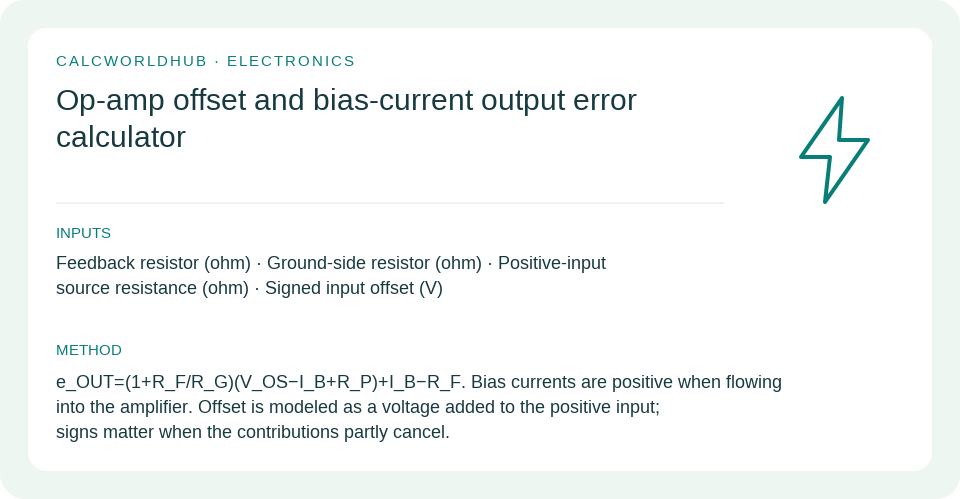
e_OUT=(1+R_F/R_G)(V_OS−I_B+R_P)+I_B−R_F.
Bias currents are positive when flowing into the amplifier. Offset is modeled as a voltage added to the positive input; signs matter when the contributions partly cancel.
Set up the calculation
Rf— Feedback resistor (ohm)- Feedback from output to inverting input.
Rg— Ground-side resistor (ohm)- Resistance from inverting input to ideal zero signal.
Rp— Positive-input source resistance (ohm)- Thevenin resistance seen by the noninverting input.
Vos— Signed input offset (V)- Effective offset added at the noninverting input.
Ibp— Positive-input bias current (A)- Signed current entering noninverting input.
Ibm— Negative-input bias current (A)- Signed current entering inverting input.
Limits of this model
Ideal closed-loop gain and DC resistors only. Does not include drift, finite open-loop gain or rail saturation.
Check this example
Feedback resistor (ohm) = 100000; Ground-side resistor (ohm) = 10000; Positive-input source resistance (ohm) = 9090.9; Signed input offset (V) = 0.00005; Positive-input bias current (A) = 2.00000000e-08; Negative-input bias current (A) = 2.20000000e-08.
- Total output error: 0.00075 V
- Offset-voltage contribution: 0.00055 V
- Bias-current contribution: 0.0002 V
With gain 11, 50 microvolt offset contributes 550 microvolts. A nearly matched source resistance removes most common bias-current error but not bias mismatch.
Reading the outputs
The total is signed; individual components show why worst-case absolute-sum budgets can exceed a nominal signed prediction.
Frequently asked questions
Why use RF parallel RG at the positive input?
It approximately cancels equal input bias currents by matching the input resistance paths.
Can offset and bias errors cancel?
Nominal signed values can cancel, but their production and temperature limits may not track.
Should datasheet maximum errors be added algebraically?
For a guaranteed bound, use sign combinations or absolute sums rather than assuming cancellation.
How do I use the Op-amp offset and bias-current output error calculator?
Enter Feedback resistor (ohm), Ground-side resistor (ohm), Positive-input source resistance (ohm), Signed input offset (V), then complete the remaining labeled fields. Match the units shown beside each field and review the result together with the assumptions below.
What is a worked example of Op-amp offset and bias-current output error?
Feedback resistor (ohm) = 100000; Ground-side resistor (ohm) = 10000; Positive-input source resistance (ohm) = 9090.9; Signed input offset (V) = 0.00005; Positive-input bias current (A) = 2.00000000e-08; Negative-input bias current (A) = 2.20000000e-08. Total output error: 0.00075 V Offset-voltage contribution: 0.00055 V Bias-current contribution: 0.0002 V With gain 11, 50 microvolt offset contributes 550 microvolts. A nearly matched source resistance removes most common bias-current error but not bias mismatch.
Background or definition reference: Analog Devices MT-038: op amp input bias current.