How to use this calculator
Check whether a contraction and bed rise have enough specific energy to pass the entered discharge without changing the upstream state.
- Enter Discharge (m³/s), Upstream width (m), Upstream depth (m), Throat width (m), then complete the remaining labeled fields. Match the units shown beside each field and review the result together with the assumptions below.
- Read the worked example below to check the expected input format and result.
- Compare another scenario by changing one input at a time. Use Reset to return to the starting values.
Open channel contraction and bed rise choking margin explained
Available upstream specific energy must cover the contracted section’s critical-flow energy, transition loss, and bed rise. The outputs give the maximum bed rise and remaining energy margin; they do not choose a downstream depth branch.
Inputs, symbols, and units
Q— Discharge (m³/s)- Steady flow before and through the transition.
b1— Upstream width (m)- Rectangular channel width before contraction.
y1— Upstream depth (m)- Known upstream depth whose velocity head contributes to available energy.
b2— Throat width (m)- Rectangular width at the raised or contracted throat.
dz— Throat bed rise (m)- Throat bed elevation minus upstream bed elevation; a negative value is a drop.
hl— Assumed transition head loss (m)- Specified loss of mechanical energy between the two sections.
Formula and method
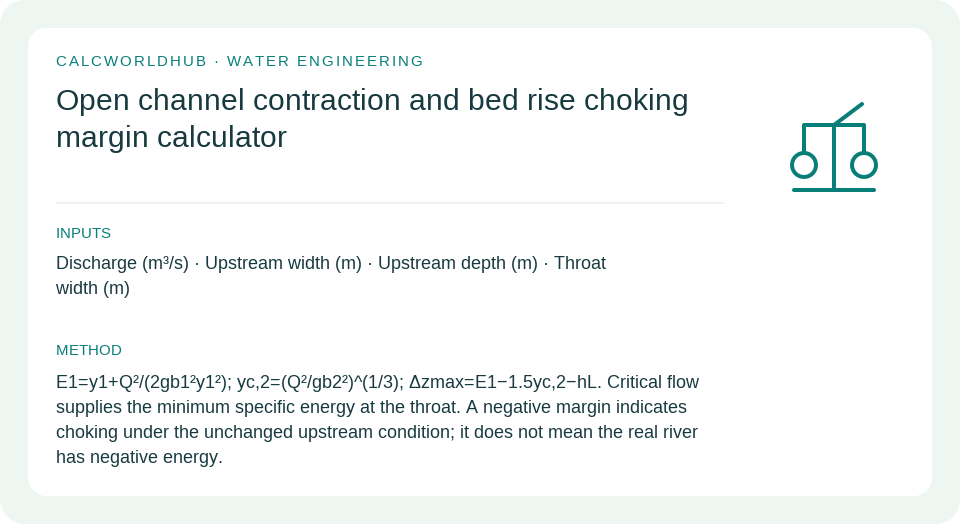
E1=y1+Q²/(2gb1²y1²); yc,2=(Q²/gb2²)^(1/3); Δzmax=E1−1.5yc,2−hL.
Critical flow supplies the minimum specific energy at the throat. A negative margin indicates choking under the unchanged upstream condition; it does not mean the real river has negative energy.
A worked scenario
Discharge (m³/s) = 8; Upstream width (m) = 5; Upstream depth (m) = 1.5; Throat width (m) = 3; Throat bed rise (m) = 0.2; Assumed transition head loss (m) = 0.05.
- Maximum bed rise without upstream adjustment: 0.160403 m
- Energy margin after entered rise: -0.039597 m
- Throat critical depth: 0.898405 m
- Additional upstream energy required: 0.039597 m
An 8 m³/s flow at 1.5 m depth narrows from 5 to 3 m, crosses a 0.2 m bed rise and loses 0.05 m head. The calculation compares available energy with the throat minimum.
Assumptions and edge cases
Rectangular hydrostatic sections, unit energy coefficient and specified losses. The page does not solve the adjusted upstream water level, jump location or unsteady response. Educational model; this is not a code-compliant design check.
Reading the outputs
All results are m of depth or mechanical head. Required additional energy is clipped at zero when no upstream adjustment is needed.
Frequently asked questions
Does a positive margin select the downstream depth?
No. It only shows that a real depth solution exists; subcritical/supercritical branch selection needs the flow controls.
Can the maximum rise be negative?
Yes. The contraction and entered losses can already need more energy than the upstream state supplies.
Is the extra required energy equal to a water-level rise?
Not exactly, because changing depth also changes upstream velocity head.
How do I use the Open channel contraction and bed rise choking margin calculator?
Enter Discharge (m³/s), Upstream width (m), Upstream depth (m), Throat width (m), then complete the remaining labeled fields. Match the units shown beside each field and review the result together with the assumptions below.
What is a worked example of Open channel contraction and bed rise choking margin?
Discharge (m³/s) = 8; Upstream width (m) = 5; Upstream depth (m) = 1.5; Throat width (m) = 3; Throat bed rise (m) = 0.2; Assumed transition head loss (m) = 0.05. Maximum bed rise without upstream adjustment: 0.160403 m Energy margin after entered rise: -0.039597 m Throat critical depth: 0.898405 m Additional upstream energy required: 0.039597 m An 8 m³/s flow at 1.5 m depth narrows from 5 to 3 m, crosses a 0.2 m bed rise and loses 0.05 m head. The calculation compares available energy with the throat minimum.
Background or definition reference: USACE HEC-RAS Hydraulic Reference Manual.
Reference access note: The linked HEC-RAS reference PDF was not retrievable during this review. The stated equation and numerical example were checked independently; verify against current official hydraulic guidance before design use.
Read our calculation methodology.