How to use this calculator
Convert round-trip optical power retention into an exponential power-decay lifetime and corresponding Lorentzian resonance linewidth.
- Enter Cavity one way length (m), Intracavity group index, First mirror power retention, Second mirror power retention, then complete the remaining labeled fields. Match the units shown beside each field and review the result together with the assumptions below.
- Read the worked example below to check the expected input format and result.
- Compare another scenario by changing one input at a time. Use Reset to return to the starting values.
Optical cavity power ringdown lifetime explained
Estimate intracavity power decay time and the corresponding resonance linewidth from cavity round-trip time and retained power per round trip.
How the calculation works
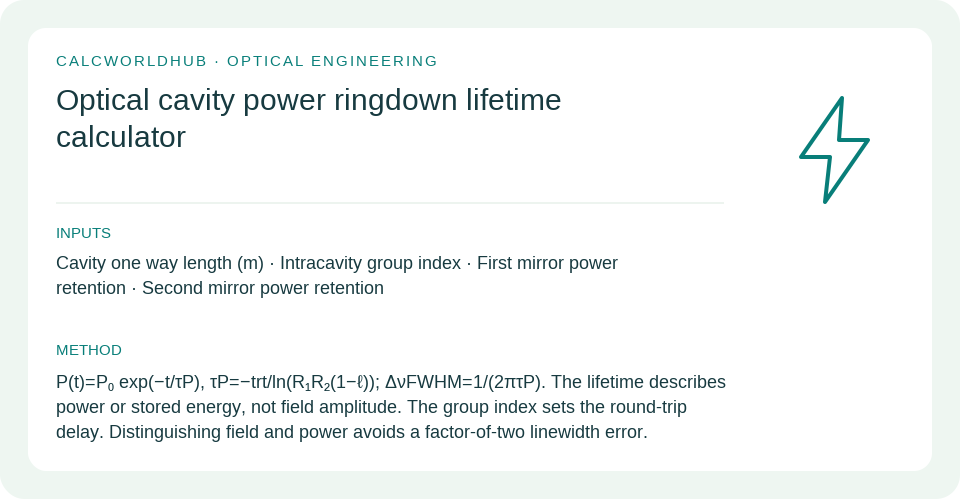
P(t)=P₀ exp(−t/τP), τP=−trt/ln(R₁R₂(1−ℓ)); ΔνFWHM=1/(2πτP).
The lifetime describes power or stored energy, not field amplitude. The group index sets the round-trip delay. Distinguishing field and power avoids a factor-of-two linewidth error.
Set up the calculation
length— Cavity one way length (m)- Physical round-trip half length for a linear cavity.
group— Intracavity group index- Index governing the round-trip envelope delay.
r1— First mirror power retention- Power fraction retained at mirror one.
r2— Second mirror power retention- Power fraction retained at mirror two.
loss— Other round trip power loss- Fractional loss in one full round trip, excluding the mirrors.
Limits of this model
Constant small-signal linear losses and no optical gain. The linewidth relation assumes a single exponential decay and a narrow resonant mode.
Check this example
Cavity one way length (m) = 0.3; Intracavity group index = 1; First mirror power retention = 0.999; Second mirror power retention = 0.999; Other round trip power loss = 0.0002.
- Power ringdown lifetime: 909.298399 ns
- Equivalent intensity resonance linewidth: 0.17503 MHz
- Round trip power retention: 0.997801
For a 0.3 m cavity with mirror retentions 0.999 each and extra loss 0.0002, power decays over many 2 ns round trips.
Reading the outputs
Power lifetime is nanoseconds; intensity linewidth is megahertz; total round-trip retention is dimensionless.
Frequently asked questions
Is this the field amplitude lifetime?
No. Field amplitude decays twice as slowly as power under the same convention.
Can I include gain?
No. This page models passive retention below one.
Why use the logarithm instead of loss directly?
The logarithm gives the exact exponential lifetime for the specified per-round-trip retention.
How do I use the Optical cavity power ringdown lifetime calculator?
Enter Cavity one way length (m), Intracavity group index, First mirror power retention, Second mirror power retention, then complete the remaining labeled fields. Match the units shown beside each field and review the result together with the assumptions below.
What is a worked example of Optical cavity power ringdown lifetime?
Cavity one way length (m) = 0.3; Intracavity group index = 1; First mirror power retention = 0.999; Second mirror power retention = 0.999; Other round trip power loss = 0.0002. Power ringdown lifetime: 909.298399 ns Equivalent intensity resonance linewidth: 0.17503 MHz Round trip power retention: 0.997801 For a 0.3 m cavity with mirror retentions 0.999 each and extra loss 0.0002, power decays over many 2 ns round trips.
Background or definition reference: MIT mirrors interferometers and thin films.