How to use this calculator
Find the self-consistent Gaussian mode of a strictly stable two-spherical-mirror optical resonator.
- Enter Mirror separation (mm), First mirror inward radius (mm), Second mirror inward radius (mm), Vacuum wavelength (nm). Match the units shown beside each field and review the result together with the assumptions below.
- Read the worked example below to check the expected input format and result.
- Compare another scenario by changing one input at a time. Use Reset to return to the starting values.
Two mirror stable resonator Gaussian waist explained
A stable two-mirror resonator supports a Gaussian mode whose waist position and size depend on both mirror curvatures and their separation. The g-parameter solution gives the Rayleigh range first; wavelength then sets the 1/e² intensity waist radius.
Inputs, symbols, and units
length— Mirror separation (mm)- Optical-axis distance between mirrors.
r1— First mirror inward radius (mm)- Signed mirror radius; positive is concave toward the cavity.
r2— Second mirror inward radius (mm)- Signed inward radius using the same convention.
wavelength— Vacuum wavelength (nm)- Monochromatic vacuum wavelength in nanometres.
Formula and method
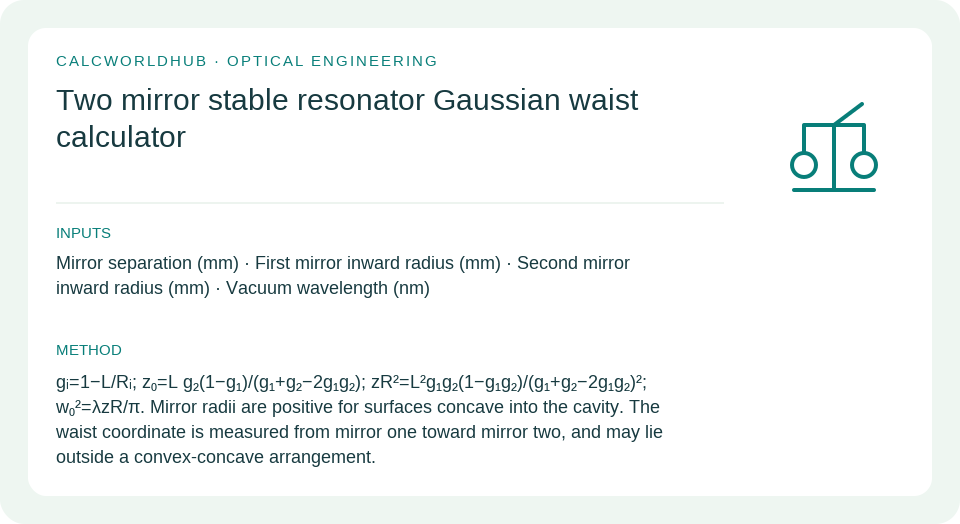
gᵢ=1−L/Rᵢ; z₀=L g₂(1−g₁)/(g₁+g₂−2g₁g₂); zR²=L²g₁g₂(1−g₁g₂)/(g₁+g₂−2g₁g₂)²; w₀²=λzR/π.
Mirror radii are positive for surfaces concave into the cavity. The waist coordinate is measured from mirror one toward mirror two, and may lie outside a convex-concave arrangement.
A worked scenario
Mirror separation (mm) = 200; First mirror inward radius (mm) = 500; Second mirror inward radius (mm) = 500; Vacuum wavelength (nm) = 1064.
- Intracavity waist radius: 0.260262 mm
- Waist coordinate from first mirror: 100 mm
- Rayleigh range: 200 mm
A symmetric 200 mm cavity with two 500 mm inward radii places its waist at the midpoint with Rayleigh range 200 mm.
Assumptions and edge cases
Paraxial empty resonator in air; marginal stability boundaries are excluded. This implementation requires 0 < g₁g₂ < 1 and finite, nonzero mirror radii; degenerate boundary configurations require separate treatment. Thermal lenses, astigmatism and finite mirror apertures require a full resonator model.
Reading the outputs
Waist radius is the Gaussian 1/e² intensity radius. Its axial coordinate and Rayleigh range are millimetres.
Frequently asked questions
What happens at the stability boundary?
The ideal mode becomes degenerate or unbounded; the page excludes those cases.
Is the waist result a diameter?
No. It is a radius at the 1/e² intensity level.
Can the two mirror radii differ?
Yes. The waist then moves away from the geometric midpoint.
How do I use the Two mirror stable resonator Gaussian waist calculator?
Enter Mirror separation (mm), First mirror inward radius (mm), Second mirror inward radius (mm), Vacuum wavelength (nm). Match the units shown beside each field and review the result together with the assumptions below.
What is a worked example of Two mirror stable resonator Gaussian waist?
Mirror separation (mm) = 200; First mirror inward radius (mm) = 500; Second mirror inward radius (mm) = 500; Vacuum wavelength (nm) = 1064. Intracavity waist radius: 0.260262 mm Waist coordinate from first mirror: 100 mm Rayleigh range: 200 mm A symmetric 200 mm cavity with two 500 mm inward radii places its waist at the midpoint with Rayleigh range 200 mm.
Background or definition reference: Newport Gaussian beam optics.
Read our calculation methodology.