How to use this calculator
Calculate OSHA total recordable and DART case rates from logged cases and employee hours.
- Enter Total OSHA-recordable cases, DART cases, Employee hours worked. Match the units shown beside each field and review the result together with the assumptions below.
- Read the worked example below to check the expected input format and result.
- Compare another scenario by changing one input at a time. Use Reset to return to the starting values.
How this calculation works
Enter total OSHA-recordable cases, the subset involving days away, restriction, or transfer, and total employee hours worked for the same establishment and reporting period. Both rates use the OSHA 200,000-hour base.
Inputs and units
recordableCases— Total OSHA-recordable cases- Whole-case count for the reporting period, including cases used in the DART count.
dartCases— DART cases- Whole-case count involving days away, restricted work, or job transfer; this must not exceed total recordable cases.
employeeHours— Employee hours worked- Total employee hours for the same establishment and reporting period.
Formula
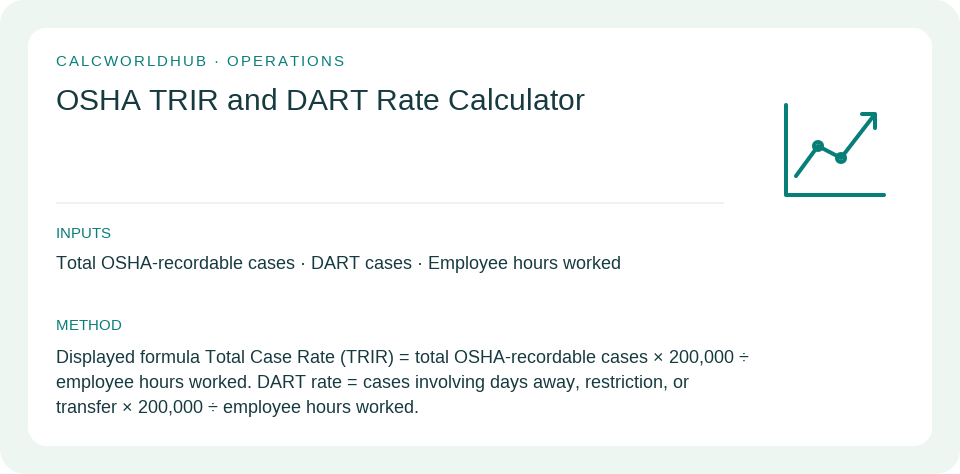
Total Case Rate (TRIR) = total OSHA-recordable cases × 200,000 ÷ employee hours worked. DART rate = cases involving days away, restriction, or transfer × 200,000 ÷ employee hours worked.
Method
Apply the same employee-hour denominator to both case counts. OSHA’s Total Case Rate covers recordable cases; DART counts the subset involving days away, restricted work, or job transfer.
Worked example
With 12 total recordable cases, 5 DART cases, and 480,000 employee hours, TRIR is 5.00 and the DART rate is 2.08 cases per 100 FTE.
Assumptions and limits
This is a rate calculation aid, not a recordability decision or compliance determination. Use the case classifications and employee hours for the same establishment and period; verify official reporting requirements with OSHA.
Frequently asked questions
What does DART include?
Cases involving days away from work, restricted work activity, or transfer to another job; it is a subset of total recordable cases.
Why use 200,000 hours?
It represents 100 full-time equivalent workers at 40 hours per week for 50 weeks.
Are the rates a compliance decision?
No. The tool calculates rates from entered counts and hours; OSHA recordability and reporting rules still govern the source data.
How do I use the OSHA TRIR and DART Rate Calculator?
Enter Total OSHA-recordable cases, DART cases, Employee hours worked. Match the units shown beside each field and review the result together with the assumptions below.
What is a worked example of OSHA TRIR and DART Rate?
With 12 total recordable cases, 5 DART cases, and 480,000 employee hours, TRIR is 5.00 and the DART rate is 2.08 cases per 100 FTE.
Reference: OSHA official incident-rate and DART case definitions. See our calculation methodology.