Page table memory size calculator
Estimate a single-level page table size from virtual address width, page size, and entry size. Enter your values below to see the result and method.
inputs.
Related calculators
These tools cover nearby questions while keeping this page focused on its own calculation.
How to use this calculator
Estimate a single-level page table size from virtual address width, page size, and entry size.
- Enter Virtual address width (bits), Page size (bytes), Page table entry size (bytes). Match the units shown beside each field and review the result together with the assumptions below.
- Read the worked example below to check the expected input format and result.
- Compare another scenario by changing one input at a time. Use Reset to return to the starting values.
Define the system or input
Estimate a single-level page table size from virtual address width, page size, and entry size.
Inputs and units
Use the units printed beside each field. These values are Virtual address width (bits), Page size (bytes), Page table entry size (bytes).
- Virtual address width (bits): Virtual address width as defined for the physical or engineering situation.
- Page size (bytes): Page size as defined for the physical or engineering situation.
- Page table entry size (bytes): Page table entry size as defined for the physical or engineering situation.
Calculation method and example
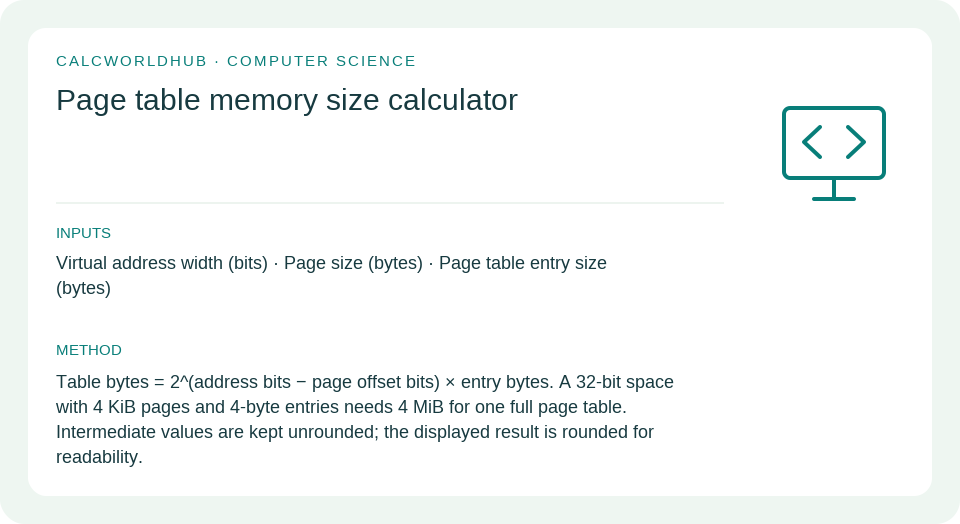
Table bytes = 2^(address bits − page offset bits) × entry bytes.
A 32-bit space with 4 KiB pages and 4-byte entries needs 4 MiB for one full page table.
Intermediate values are kept unrounded; the displayed result is rounded for readability.
Interpreting the output
The result describes a flat page table with one entry per virtual page. Actual multi-level or sparse page tables can occupy less memory because unused lower-level tables need not be allocated.
Assumptions and limitations
Assumes byte-addressed virtual memory and one flat table covering the entire address space; multi-level tables use less resident memory.
Frequently asked questions
How many page-table entries does the estimate count?
It assumes one entry for every virtual page: 2^(virtual-address bits − page-offset bits). Multiplying by entry bytes gives the single-level table size.
Does the result include a multi-level page table?
No. This is the size of a flat single-level table. Multi-level tables allocate lower levels on demand and can use less memory for sparse address spaces.
When is the addressable memory capacity more useful than the page table memory size?
This page calculates: Estimate a single-level page table size from virtual address width, page size, and entry size. The related calculator focuses on Addressable memory capacity calculator. Use that page if its named output is the quantity you need.
How do I use the Page table memory size calculator?
Enter Virtual address width (bits), Page size (bytes), Page table entry size (bytes). Match the units shown beside each field and review the result together with the assumptions below.
What is a worked example of Page table memory size?
Table bytes = 2^(address bits − page offset bits) × entry bytes. A 32-bit space with 4 KiB pages and 4-byte entries needs 4 MiB for one full page table. Intermediate values are kept unrounded; the displayed result is rounded for readability.
Read the calculation methodology and privacy policy.