Partial permutation count calculator
Count ordered selections of r distinct items chosen from n distinct items.
Calculator
How to use this calculator
Count ordered selections of r distinct items chosen from n distinct items.
- Enter Number n, Selection r. Match the units shown beside each field and review the result together with the assumptions below.
- Read the worked example below to check the expected input format and result.
- Compare another scenario by changing one input at a time. Use Reset to return to the starting values.
Partial permutation count calculator
Count ordered selections of r distinct items chosen from n distinct items.
Inputs and units
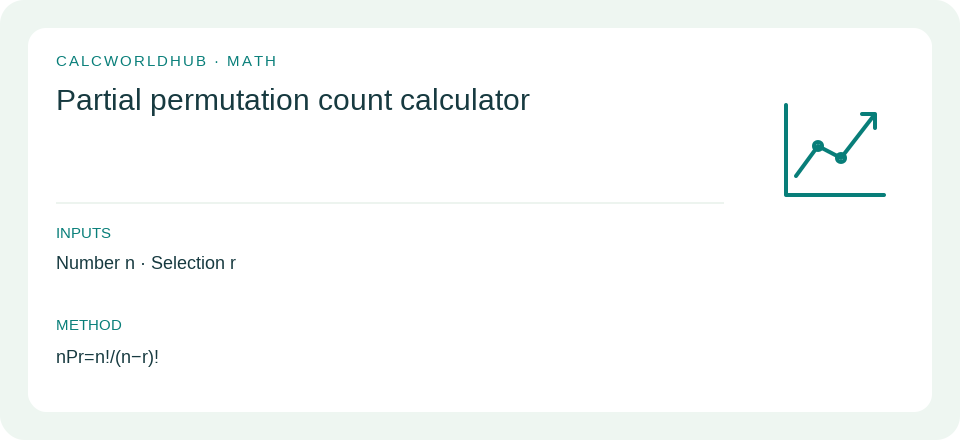
- Number n: Total number of distinct items; enter a nonnegative whole number.
- Selection r: A whole-number group/selection size. For group allocations, all sizes must sum exactly to n.
Formula and method
nPr=n!/(n−r)!
Worked example
Choosing and ordering 3 of 8 items gives 8·7·6=336 arrangements.
Interpreting the result
Order matters, so this count is larger than the corresponding unordered combination when r>1.
Assumptions and limits
n and r must be whole numbers with 0≤r≤n; selecting zero items has one empty arrangement.
Frequently asked questions
Which inputs determine this result?
The visible inputs are Number n, Selection r. Each is used by the displayed formula; the calculator does not use any other hidden measurement.
When does this method apply?
n and r must be whole numbers with 0≤r≤n; selecting zero items has one empty arrangement.
How do I use the Partial permutation count calculator?
Enter Number n, Selection r. Match the units shown beside each field and review the result together with the assumptions below.
What is a worked example of Partial permutation count?
Choosing and ordering 3 of 8 items gives 8·7·6=336 arrangements.
What does the Partial permutation count calculator calculate?
Count ordered selections of r distinct items chosen from n distinct items.
See the calculation methodology.
Good calculators show their work.
CalcWorldHub is built around clear inputs and visible assumptions. Results are estimates for planning; check official sources or your provider’s terms when exact figures matter.