How to use this calculator
Convert an assumed ideal-gas pressure expansion into exit kinetic energy with an entered efficiency.
- Enter Inlet stagnation temperature (K), Inlet stagnation pressure (kPa abs), Assumed exit static pressure (kPa abs), Heat-capacity ratio, then complete the remaining labeled fields. Match the units shown beside each field and review the result together with the assumptions below.
- Read the worked example below to check the expected input format and result.
- Compare another scenario by changing one input at a time. Use Reset to return to the starting values.
Perfect gas nozzle expansion velocity explained
Inputs, symbols, and units
t— Inlet stagnation temperature (K)- Inlet stagnation temperature (K).
p— Inlet stagnation pressure (kPa abs)- Inlet stagnation pressure (kPa abs).
pe— Assumed exit static pressure (kPa abs)- Assumed exit static pressure (kPa abs).
g— Heat-capacity ratio- Heat-capacity ratio.
cp— Constant cp (kJ/kg/K)- Constant cp (kJ/kg/K).
e— Nozzle kinetic-energy efficiency- Nozzle kinetic-energy efficiency.
Formula and method
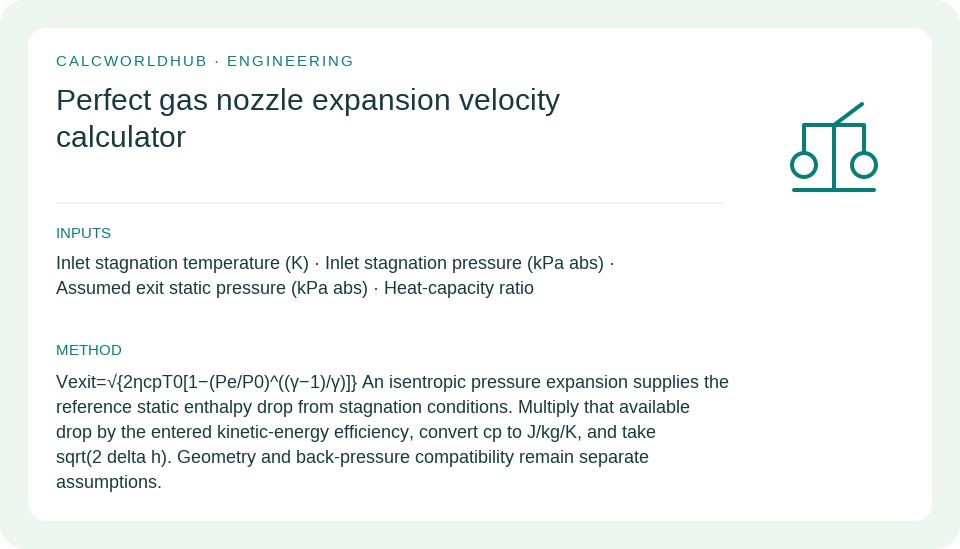
Vexit=√{2ηcpT0[1−(Pe/P0)^((γ−1)/γ)]}
An isentropic pressure expansion supplies the reference static enthalpy drop from stagnation conditions. Multiply that available drop by the entered kinetic-energy efficiency, convert cp to J/kg/K, and take sqrt(2 delta h). Geometry and back-pressure compatibility remain separate assumptions.
A worked scenario
Inlet stagnation temperature (K) = 300; Inlet stagnation pressure (kPa abs) = 500; Assumed exit static pressure (kPa abs) = 100; Heat-capacity ratio = 1.4; Constant cp (kJ/kg/K) = 1.005; Nozzle kinetic-energy efficiency = 0.95.
- Estimated nozzle exit speed: 459.52266797 m/s
The 0.20 exit-to-inlet pressure ratio supplies the expansion energy; the 95% efficiency is applied to the ideal kinetic-energy change.
Assumptions and edge cases
Negligible inlet velocity; appropriate nozzle geometry and matching back pressure are assumed. Choking, shocks, area ratio, and off-design flow are not solved.
Frequently asked questions
Is cp entered in J/kg/K?
Enter kJ/kg/K; the code converts to joules.
Can exit pressure exceed stagnation pressure?
No.
Does this determine mass flow?
No, area and throat conditions are not supplied.
How do I use the Perfect gas nozzle expansion velocity calculator?
Enter Inlet stagnation temperature (K), Inlet stagnation pressure (kPa abs), Assumed exit static pressure (kPa abs), Heat-capacity ratio, then complete the remaining labeled fields. Match the units shown beside each field and review the result together with the assumptions below.
What is a worked example of Perfect gas nozzle expansion velocity?
Inlet stagnation temperature (K) = 300; Inlet stagnation pressure (kPa abs) = 500; Assumed exit static pressure (kPa abs) = 100; Heat-capacity ratio = 1.4; Constant cp (kJ/kg/K) = 1.005; Nozzle kinetic-energy efficiency = 0.95. Estimated nozzle exit speed: 459.52266797 m/s The 0.20 exit-to-inlet pressure ratio supplies the expansion energy; the 95% efficiency is applied to the ideal kinetic-energy change.
Read our calculation methodology.