Pipe Reynolds number calculator
Estimate Reynolds number for internal flow using hydraulic diameter derived from area and wetted perimeter.
Calculator
How to use this calculator
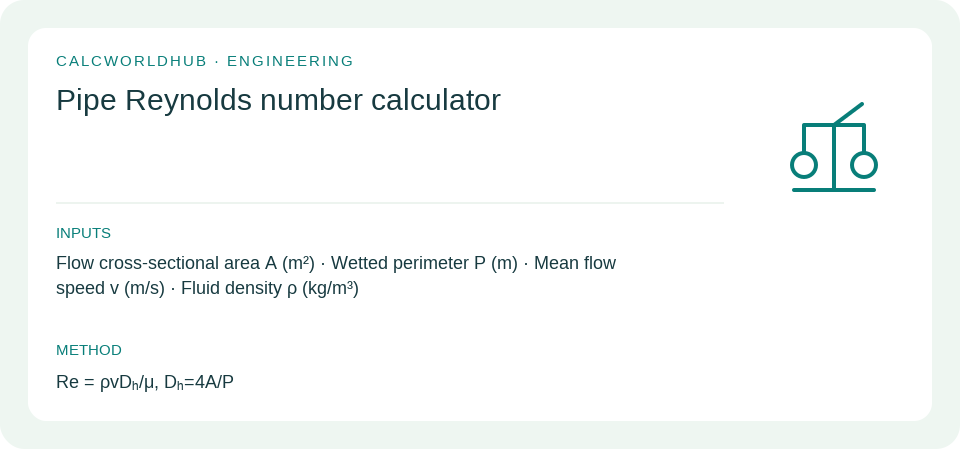
Use this tool when you know the flow area A and wetted perimeter P. It first forms the hydraulic diameter Dh = 4A/P, then uses Re = ρvDh/μ. If you already have the inside diameter of a full circular pipe, the related Pipe flow Reynolds number calculator accepts that diameter directly.
- Enter the area occupied by flowing fluid in m² and wetted perimeter in m, then mean speed, density and dynamic viscosity in the stated SI units. Use the same section and operating condition for all inputs.
- Use the worked example to check the input basis and units.
- Change one input at a time to compare scenarios; Reset restores the starting values.
Pipe Reynolds number calculator
Use this tool when you know the flow area A and wetted perimeter P. It first forms the hydraulic diameter Dh = 4A/P, then uses Re = ρvDh/μ. If you already have the inside diameter of a full circular pipe, the related Pipe flow Reynolds number calculator accepts that diameter directly.
Inputs and units
- Flow cross-sectional area A (m²): Area occupied by the flowing fluid, in square metres, measured perpendicular to the mean flow. Use the flow area rather than the pipe-wall material area.
- Wetted perimeter P (m): Length of the boundary in contact with flowing fluid, in metres; hydraulic diameter is four times area divided by this perimeter.
- Mean flow speed v (m/s): Bulk average fluid speed through the section in m/s; zero is a valid no-flow case.
- Fluid density ρ (kg/m³): Fluid mass per volume in kg/m³ at the modeled flow conditions.
- Dynamic viscosity μ (Pa·s): Dynamic viscosity in Pa·s at the modeled temperature; a positive value sets the viscous scale.
Formula and method
Re = ρvDₕ/μ, Dₕ=4A/P
Worked example
For A = 0.002 m² and P = 0.16 m, Dh = 4 × 0.002 / 0.16 = 0.05 m. With ρ = 1000 kg/m³, v = 1.2 m/s and μ = 0.001 Pa·s, Re = 60,000. The number is dimensionless; it is not a pressure or stress.
Interpreting the result
Re is dimensionless and compares inertial with viscous effects; interpretation thresholds depend on geometry and flow development.
Assumptions and limits
Area, perimeter, density, and viscosity must be positive; speed may be zero. Assumes a representative mean speed and Newtonian-fluid dynamic viscosity.
Sources and method
- Defines Reynolds number as the inertial-to-viscous flow ratio; hydraulic diameter 4A/P is independently obtained from the wetted perimeter definition. OpenStax University Physics Volume 1: viscosity and turbulence
NASA NTRS report, section 3.1: Basic Definitions for Internal Flows
Frequently asked questions
Which area should I enter?
Enter the cross-sectional area occupied by the fluid, not the material area of the pipe wall.
Is hydraulic diameter the same as pipe diameter?
For a full circular pipe they are equal. For another section, calculate 4A/P using that section’s flow area and wetted perimeter.
Should an open water surface count toward wetted perimeter?
Wetted perimeter is the boundary in contact with the fluid and the solid wall; an open free surface is not a wetted wall.
Does Reynolds number give pressure loss?
No. Pressure-loss calculations need additional geometry, flow and resistance information. This result alone is a dimensionless flow descriptor.
See the calculation methodology.
Related calculators
Good calculators show their work.
CalcWorldHub is built around clear inputs and visible assumptions. Results are estimates for planning; check official sources or your provider’s terms when exact figures matter.