How to use this calculator
Classify within-row plant gaps against a target spacing to summarize planter stand quality.
- Enter Theoretical within-row spacing (cm), Measured gaps between successive plants (cm). Match the units shown beside each field and review the result together with the assumptions below.
- Read the worked example below to check the expected input format and result.
- Compare another scenario by changing one input at a time. Use Reset to return to the starting values.
How this calculation works
The planter spacing indices compare every measured gap between neighboring emerged plants with theoretical spacing. Intervals below half the target indicate multiples; intervals from one-half through one-and-a-half target are classified as acceptable singles; larger intervals are classified as skips.
Inputs and units
theoreticalSpacing— Theoretical within-row spacing (cm)- Target plant-to-plant spacing assuming no misses, multiples, or placement variability.
measuredSpacings— Measured gaps between successive plants (cm)- Enter successive measured plant spacings in the same unit. Use a consistent field sampling procedure.
Formula
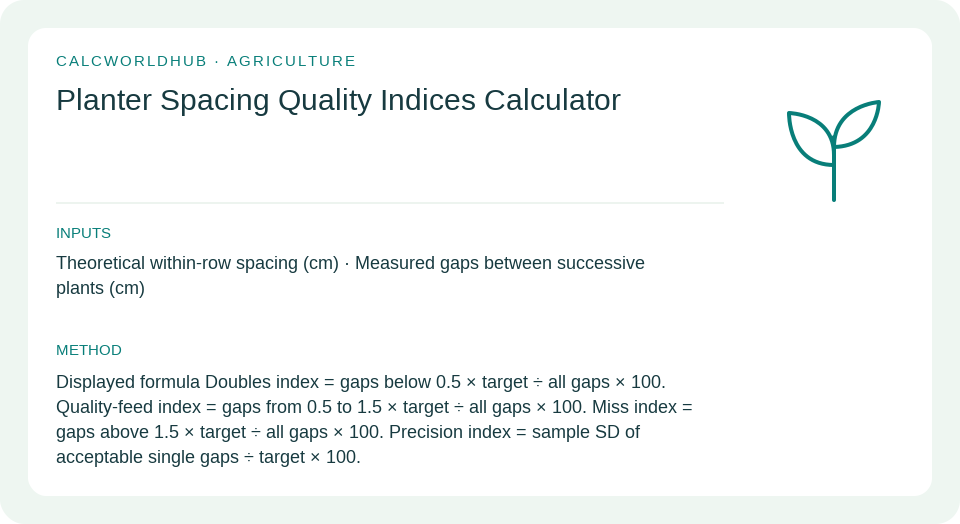
Doubles index = gaps below 0.5 × target ÷ all gaps × 100. Quality-feed index = gaps from 0.5 to 1.5 × target ÷ all gaps × 100. Miss index = gaps above 1.5 × target ÷ all gaps × 100. Precision index = sample SD of acceptable single gaps ÷ target × 100.
Method
Measure successive within-row plant gaps in one unit and use the planter target spacing. The precision index uses only acceptable-single gaps; miss and doubles indices retain the full observed sample.
Worked example
With a 20 cm target, measured gaps of 18, 20, 22, 42, and 78 cm produce a 0.00% doubles index, 60.00% quality-feed index, 40.00% miss index, and 10.00% precision index.
Assumptions and limits
Spacing classifications depend on the target spacing and the sampling method. This calculator summarizes stand spacing; it does not diagnose planter, seed, soil, or emergence causes.
Frequently asked questions
What does the doubles index count?
Gaps shorter than half the target spacing, classified as multiple-plant spacings.
Which gaps enter the precision index?
Only gaps between one-half and one-and-a-half times the target spacing.
How are skips classified?
Gaps above one-and-a-half target spacing count toward the miss index; larger gaps are still misses, not extra records.
How do I use the Planter Spacing Quality Indices Calculator?
Enter Theoretical within-row spacing (cm), Measured gaps between successive plants (cm). Match the units shown beside each field and review the result together with the assumptions below.
What is a worked example of Planter Spacing Quality Indices?
With a 20 cm target, measured gaps of 18, 20, 22, 42, and 78 cm produce a 0.00% doubles index, 60.00% quality-feed index, 40.00% miss index, and 10.00% precision index.
Reference: Iowa State University Extension plant-spacing classification and accuracy indices. See our calculation methodology.