How to use this calculator
Estimate how many monthly payments it may take for a mortgage balance to reach a chosen LTV target.
- Enter Current unpaid principal balance ($), Original property value ($), Fixed annual interest rate (%), Monthly principal-and-interest payment ($), then complete the remaining labeled fields. Match the units shown beside each field and review the result together with the assumptions below.
- Read the worked example below to check the expected input format and result.
- Compare another scenario by changing one input at a time. Use Reset to return to the starting values.
How this calculation works
Private mortgage insurance timing depends on the unpaid principal balance relative to the property’s original value and on the loan’s payment history and servicing rules. This estimator projects the balance under a fixed-rate monthly payment, then counts when it crosses the target ratio you enter; it does not decide whether a servicer must cancel coverage.
Inputs and units
balance— Current unpaid principal balance ($)- Enter the mortgage principal remaining today.
originalValue— Original property value ($)- Use the value relevant to the loan’s original LTV calculation.
annualRate— Fixed annual interest rate (%)- Enter the nominal annual note rate; the model divides it by 12.
monthlyPI— Monthly principal-and-interest payment ($)- Exclude taxes, insurance, escrow, and PMI from this amount.
extraPrincipal— Extra principal per month ($)- Enter additional principal paid each month; use 0 if none.
targetLtv— Target loan-to-value (%)- Choose the balance threshold to model; this is not an eligibility decision.
Formula
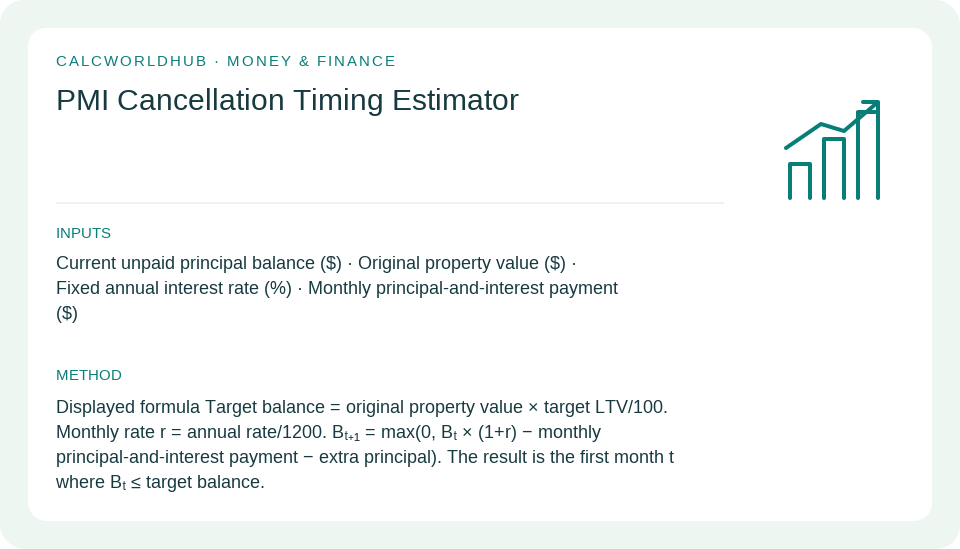
Target balance = original property value × target LTV/100. Monthly rate r = annual rate/1200. Bₜ₊₁ = max(0, Bₜ × (1+r) − monthly principal-and-interest payment − extra principal). The result is the first month t where Bₜ ≤ target balance.
Method
Enter the current unpaid principal, the property’s original value used for the loan, the fixed annual interest rate, the monthly principal-and-interest payment, any additional principal payment, and a target LTV percentage. The model accrues one month of interest, subtracts the payment, and repeats until the balance reaches the target.
Worked example
With a $210,000 balance, $250,000 original value, 6% annual rate, $1,400 monthly principal-and-interest payment, $100 extra principal, and an 80% target, the target balance is $200,000. Applying monthly interest and payments gives a first crossing in month 22; modeled interest over those 22 payments is about $22,562.51.
Assumptions and limits
This is a constant-rate amortization estimate. It excludes taxes, insurance, escrow, fees, payment timing variations, property-value changes, subordinate liens, and delinquency. Reaching an LTV target does not establish PMI cancellation eligibility; contact the servicer and check current requirements for the loan. The CFPB describes general 80% request and 78% automatic-termination milestones for covered loans, subject to conditions.
Frequently asked questions
Does reaching 80% LTV automatically cancel PMI?
Not always. CFPB guidance describes a general right to request cancellation at 80% of original value and a general automatic-termination point at 78% for covered loans, but eligibility conditions apply.
Should I enter the home’s current market value?
For the common original-value milestone, use the value relevant to the loan’s original calculation. Servicer or investor rules can differ; confirm the applicable value with your servicer.
Does the payment include property tax and homeowners insurance?
No. Enter principal and interest only. Escrow charges and PMI premiums do not reduce principal in this estimate.
Can extra principal change the estimate?
Yes. Enter the additional amount that is actually applied to principal each month. The result assumes it continues every modeled month.
How do I use the PMI Cancellation Timing Estimator?
Enter Current unpaid principal balance ($), Original property value ($), Fixed annual interest rate (%), Monthly principal-and-interest payment ($), then complete the remaining labeled fields. Match the units shown beside each field and review the result together with the assumptions below.
Reference: Consumer Financial Protection Bureau PMI cancellation and termination guidance. See our calculation methodology.