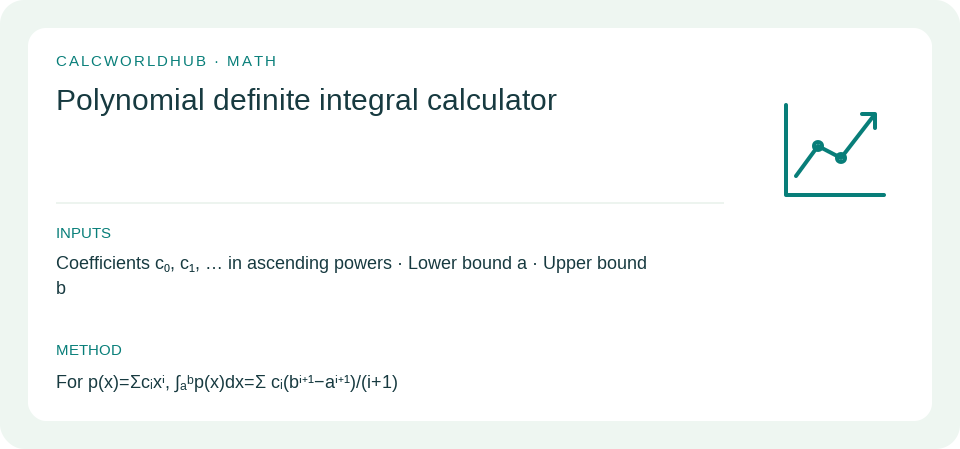
How to use this calculator
Evaluate the signed definite integral of a polynomial between two bounds by integrating each coefficient term exactly.
- Enter Coefficients c₀, c₁, … in ascending powers, Lower bound a, Upper bound b. Match the units shown beside each field and review the result together with the assumptions below.
- Read the worked example below to check the expected input format and result.
- Compare another scenario by changing one input at a time. Use Reset to return to the starting values.
How Polynomial definite integral calculator works
Evaluate the signed definite integral of a polynomial between two bounds by integrating each coefficient term exactly.
Inputs and units
- Coefficients c₀, c₁, … in ascending powers: Comma-separated coefficients c₀,c₁,… in ascending powers: c₀+c₁x+c₂x²+… .
- Lower bound a: Lower integration bound a.
- Upper bound b: Upper integration bound b; b<a is allowed and reverses the signed result.
Formula and method
For p(x)=Σcᵢxⁱ, ∫ₐᵇp(x)dx=Σ cᵢ(bⁱ⁺¹−aⁱ⁺¹)/(i+1)
Worked example
For p(x)=x² from 0 to 2, the antiderivative is x³/3, so the integral is 8/3≈2.666667.
Interpreting the result
The result is signed net accumulation: reversing the bounds changes its sign. It equals geometric area only when p stays nonnegative on the interval.
Assumptions and limits
Coefficients are ordered from the constant term upward. Polynomial integration is exact algebraically, but the displayed decimal is rounded; units are coefficient-times-x units.
Sources and method
- Definite integral properties, signed bounds, and evaluation context. OpenStax, Calculus Volume 1, The Definite Integral
Frequently asked questions
Why can an integral be negative?
A definite integral is signed accumulation; negative values mean the polynomial contributes net negative area under the axis.
Is it the same as total area?
Only if the polynomial is nonnegative on the whole interval; otherwise total geometric area requires splitting at roots.
How do I use the Polynomial definite integral calculator?
Enter Coefficients c₀, c₁, … in ascending powers, Lower bound a, Upper bound b. Match the units shown beside each field and review the result together with the assumptions below.
What is a worked example of Polynomial definite integral?
For p(x)=x² from 0 to 2, the antiderivative is x³/3, so the integral is 8/3≈2.666667.
What does the Polynomial definite integral calculator calculate?
Evaluate the signed definite integral of a polynomial between two bounds by integrating each coefficient term exactly.