How to use this calculator
Evaluate the second derivative of a polynomial at x to measure its local curvature under the supplied coordinate scale.
- Enter Coefficients a₀, a₁, … in ascending powers, Evaluation point x. Match the units shown beside each field and review the result together with the assumptions below.
- Read the worked example below to check the expected input format and result.
- Compare another scenario by changing one input at a time. Use Reset to return to the starting values.
How Polynomial second derivative calculator works
Evaluate the second derivative of a polynomial at x to measure its local curvature under the supplied coordinate scale.
Inputs and units
- Coefficients a₀, a₁, … in ascending powers: Finite polynomial coefficients a₀,a₁,… in ascending powers; constant and linear polynomials have a valid second derivative of zero.
- Evaluation point x: Finite evaluation point x where the second derivative is computed.
Formula and method
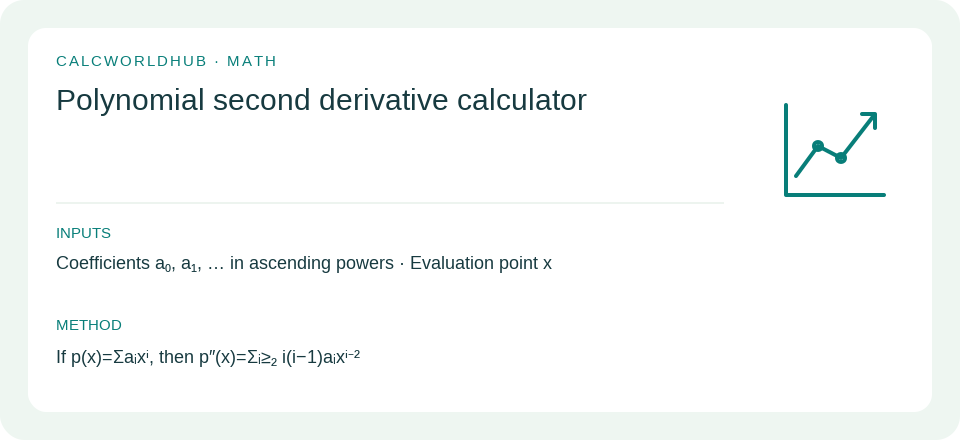
If p(x)=Σaᵢxⁱ, then p″(x)=Σᵢ≥₂ i(i−1)aᵢxⁱ⁻²
Worked example
For p(x)=1+2x+3x²+4x³, p″(x)=6+24x; at x=2 the result is 54.
Interpreting the result
A positive second derivative indicates local upward concavity and a negative value downward concavity; zero indicates no local quadratic curvature at that point.
Assumptions and limits
Coefficients are ordered from constant term upward. Polynomials of degree zero or one have second derivative zero; units are output units per x-unit squared.
Sources and method
- Power rule and derivatives of polynomials. OpenStax, Calculus Volume 1, Differentiation Rules
Frequently asked questions
Does the evaluation point matter for every polynomial?
No. A quadratic has constant second derivative, while higher-degree polynomials can vary with x.
What does zero curvature imply?
The second derivative is zero at that point; it does not by itself mean the polynomial is locally constant.
How do I use the Polynomial second derivative calculator?
Enter Coefficients a₀, a₁, … in ascending powers, Evaluation point x. Match the units shown beside each field and review the result together with the assumptions below.
What is a worked example of Polynomial second derivative?
For p(x)=1+2x+3x²+4x³, p″(x)=6+24x; at x=2 the result is 54.
What does the Polynomial second derivative calculator calculate?
Evaluate the second derivative of a polynomial at x to measure its local curvature under the supplied coordinate scale.