How to use this calculator
Summarize the asymmetry of a numeric dataset with its third central moment divided by the cube of its population standard deviation.
- Enter Observations, comma-separated. Match the units shown beside each field and review the result together with the assumptions below.
- Read the worked example below to check the expected input format and result.
- Compare another scenario by changing one input at a time. Use Reset to return to the starting values.
How Population skewness calculator works
Summarize the asymmetry of a numeric dataset with its third central moment divided by the cube of its population standard deviation.
Inputs and units
- Observations, comma-separated: Comma-separated observations; each value contributes equally to the mean and central moments.
Formula and method
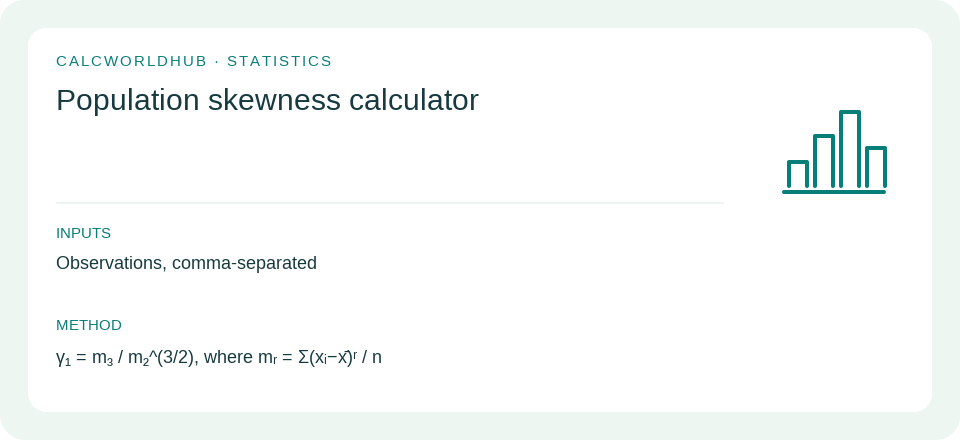
γ₁ = m₃ / m₂^(3/2), where mᵣ = Σ(xᵢ−x̄)ʳ / n
Worked example
For 4, 7, 7, 10, 12, the mean is 8, m₂=7.6, m₃=1.2, and moment skewness is 1.2/7.6^(3/2)≈0.0573.
Interpreting the result
A positive value indicates a longer right tail, a negative value a longer left tail, and zero symmetry in the third moment; it does not describe every distribution feature.
Assumptions and limits
This is population moment skewness computed from the supplied list, not an unbiased small-sample correction. Estimates can be unstable for short or outlier-heavy samples.
Frequently asked questions
Does positive skewness mean most values are high?
Not necessarily. It indicates the third-moment balance is pulled toward a longer or more extreme right tail.
Is this a bias-corrected sample skewness?
No. It uses population central moments of the entered values.
How do I use the Population skewness calculator?
Enter Observations, comma-separated. Match the units shown beside each field and review the result together with the assumptions below.
What is a worked example of Population skewness?
For 4, 7, 7, 10, 12, the mean is 8, m₂=7.6, m₃=1.2, and moment skewness is 1.2/7.6^(3/2)≈0.0573.
What does the Population skewness calculator calculate?
Summarize the asymmetry of a numeric dataset with its third central moment divided by the cube of its population standard deviation.