Pump power by speed affinity law calculator
Estimate pump power change when a geometrically unchanged pump runs at a different speed. Enter your values below to see the result and method.
inputs.
Related calculators
These tools cover nearby questions while keeping this page focused on its own calculation.
How to use this calculator
Estimate pump power change when a geometrically unchanged pump runs at a different speed.
- Enter Reference power (kW), Reference speed (rpm), New speed (rpm). Match the units shown beside each field and review the result together with the assumptions below.
- Read the worked example below to check the expected input format and result.
- Compare another scenario by changing one input at a time. Use Reset to return to the starting values.
Define the component and operating point
For the same rotodynamic pump under similar conditions, ideal power scales with the cube of rotational speed. The result is an affinity-law estimate, not a motor-efficiency prediction.
Inputs and units
Enter a baseline power in kW and positive reference and target speeds for the same pump and power definition.
- Reference power (kW): Baseline power P₁ at reference speed; keep the same shaft or hydraulic power definition.
- Reference speed (rpm): Baseline pump speed N₁; it must be positive.
- New speed (rpm): Target pump speed N₂ for the same pump and similar conditions.
Design equation and example
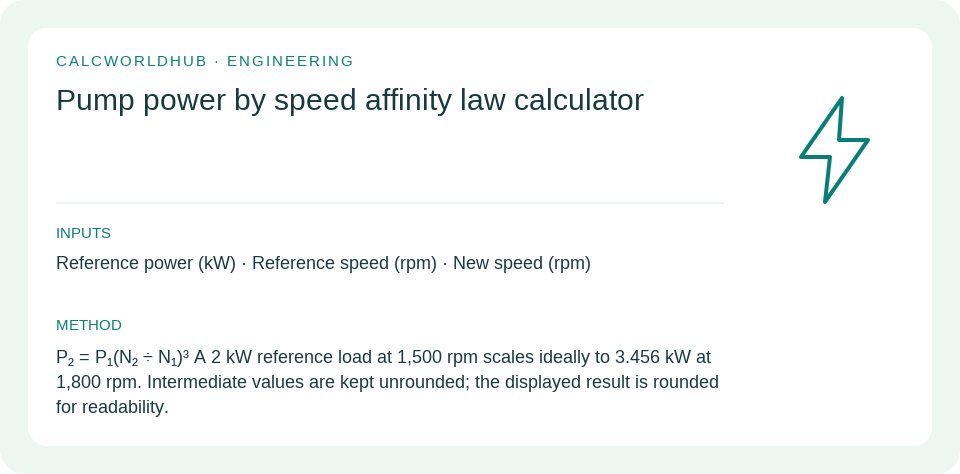
P₂ = P₁(N₂ ÷ N₁)³
A 2 kW reference load at 1,500 rpm scales ideally to 3.456 kW at 1,800 rpm.
Intermediate values are kept unrounded; the displayed result is rounded for readability.
Applying the result in a system
The ideal scaling assumes similar operation and the same definition of pump power. Motor input can differ because efficiency and drive losses vary.
Assumptions and limitations
Approximate affinity law; motor efficiency, control losses, and the real system curve are not included.
Frequently asked questions
Which measurements belong in the pump power by speed affinity law?
Use the same pump power definition for the baseline and a positive speed ratio.
What can make a real installation differ from this pump power by speed affinity law estimate?
Approximate affinity law; motor efficiency, control losses, and the real system curve are not included.
How do I use the Pump power by speed affinity law calculator?
Enter Reference power (kW), Reference speed (rpm), New speed (rpm). Match the units shown beside each field and review the result together with the assumptions below.
What is a worked example of Pump power by speed affinity law?
P₂ = P₁(N₂ ÷ N₁)³ A 2 kW reference load at 1,500 rpm scales ideally to 3.456 kW at 1,800 rpm. Intermediate values are kept unrounded; the displayed result is rounded for readability.
What does the Pump power by speed affinity law calculator calculate?
Estimate pump power change when a geometrically unchanged pump runs at a different speed.
Read the calculation methodology and privacy policy.