How to use this calculator
Calculate admissible pure-fluid cubic-EOS volume branches and fugacity using critical constants and an acentric factor.
- Enter Fluid temperature (K), Absolute pressure (Pa), Critical temperature (K), Critical pressure (Pa), then complete the remaining labeled fields. Match the units shown beside each field and review the result together with the assumptions below.
- Read the worked example below to check the expected input format and result.
- Compare another scenario by changing one input at a time. Use Reset to return to the starting values.
Pure-fluid Peng Robinson roots and fugacity explained
Use Fluid temperature (K) with Absolute pressure (Pa) to reproduce the sample calculation, then review the stated limits before carrying the result into another scenario.
Inputs, symbols, and units
T— Fluid temperature (K)- Fluid temperature (K). Enter the value for this state; the units shown are used without an unstated conversion.
p— Absolute pressure (Pa)- Absolute pressure (Pa). Enter the value for this state; the units shown are used without an unstated conversion.
Tc— Critical temperature (K)- Critical temperature (K). Enter the value for this state; the units shown are used without an unstated conversion.
pc— Critical pressure (Pa)- Critical pressure (Pa). Enter the value for this state; the units shown are used without an unstated conversion.
w— Acentric factor- Acentric factor. Enter the value for this state; the units shown are used without an unstated conversion.
phase— Requested root branch- Vapor selects the largest admissible real volume root; liquid selects the smallest. A root branch is not a phase-stability proof. Choose vapor, liquid.
Formula and method
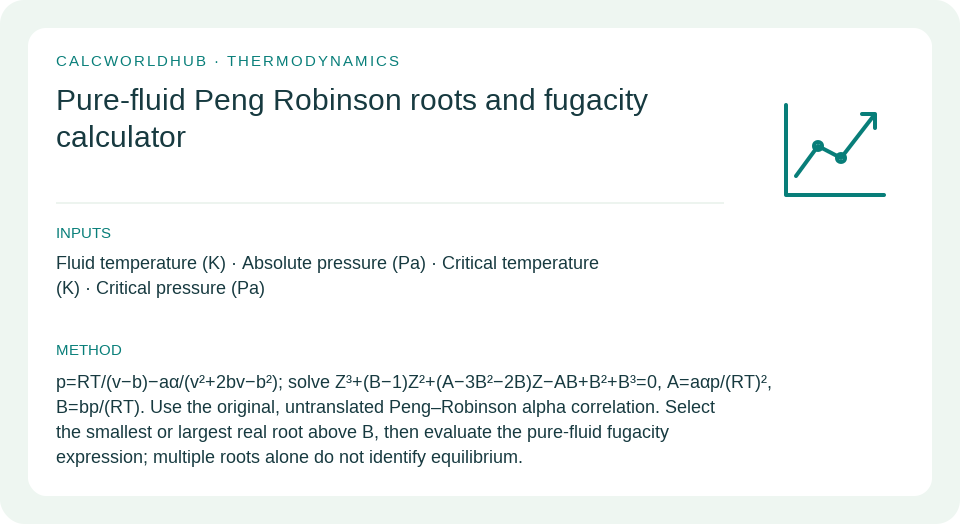
p=RT/(v−b)−aα/(v²+2bv−b²); solve Z³+(B−1)Z²+(A−3B²−2B)Z−AB+B²+B³=0, A=aαp/(RT)², B=bp/(RT).
Use the original, untranslated Peng–Robinson alpha correlation. Select the smallest or largest real root above B, then evaluate the pure-fluid fugacity expression; multiple roots alone do not identify equilibrium.
A worked scenario
Fluid temperature (K) = 300; Absolute pressure (Pa) = 5000000; Critical temperature (K) = 190.564; Critical pressure (Pa) = 4599200; Acentric factor = 0.011; Requested root branch = vapor.
- Selected compressibility factor: 0.901766
- Selected molar volume: 0.00045 m³/mol
- Fugacity coefficient: 0.901317
The entered methane critical properties at 300 K and 5 MPa give a vapor-root compressibility of 0.901766 and molar volume 0.000449862 m³/mol. Fugacity coefficient 0.901317 measures departure from ideal chemical potential, beyond a pressure-only state estimate.
Assumptions and edge cases
Pure fluid only, original acentric-factor alpha fit; no mixing rules, volume translation or automatic phase-equilibrium selection. Near repeated cubic roots numerical conditioning deteriorates.
Reading the outputs
Z is dimensionless, molar volume is m³/mol and fugacity coefficient multiplies pressure to give fugacity.
Frequently asked questions
Does selecting liquid prove the fluid is stable liquid?
No. Root selection is a branch convention; equilibrium requires comparing chemical potentials or fugacities.
Can only one real root occur?
Yes. Both branch selections then return the same admissible root.
Can I use a gas-mixture average critical temperature?
No. A mixture requires component parameters and mixing rules.
How do I use the Pure-fluid Peng Robinson roots and fugacity calculator?
Enter Fluid temperature (K), Absolute pressure (Pa), Critical temperature (K), Critical pressure (Pa), then complete the remaining labeled fields. Match the units shown beside each field and review the result together with the assumptions below.
What is a worked example of Pure-fluid Peng Robinson roots and fugacity?
Fluid temperature (K) = 300; Absolute pressure (Pa) = 5000000; Critical temperature (K) = 190.564; Critical pressure (Pa) = 4599200; Acentric factor = 0.011; Requested root branch = vapor. Selected compressibility factor: 0.901766 Selected molar volume: 0.00045 m³/mol Fugacity coefficient: 0.901317 The entered methane critical properties at 300 K and 5 MPa give a vapor-root compressibility of 0.901766 and molar volume 0.000449862 m³/mol. Fugacity coefficient 0.901317 measures departure from ideal chemical potential, beyond a pressure-only state estimate.
Background or definition reference: NIST TDE original Peng–Robinson parameters.
Read our calculation methodology.