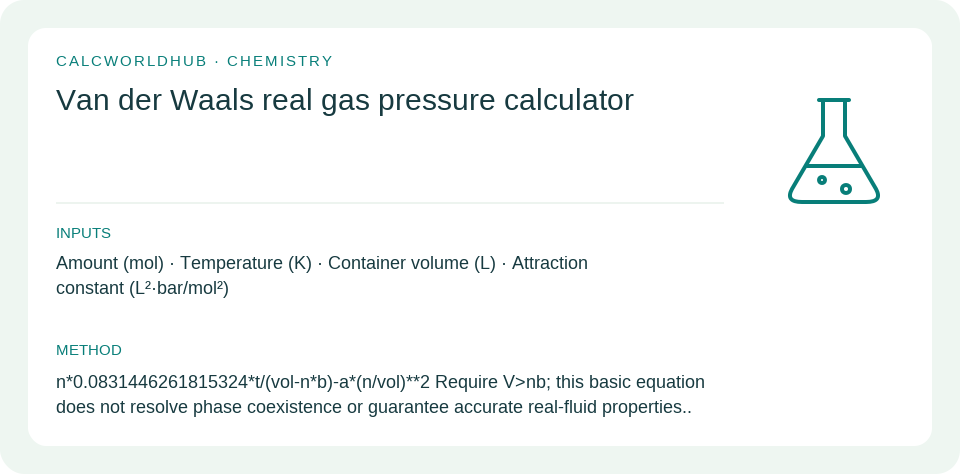
How to use this calculator
Evaluate a supplied van der Waals equation of state beyond the ideal-gas approximation.
- Enter Amount (mol), Temperature (K), Container volume (L), Attraction constant (L²·bar/mol²), then complete the remaining labeled fields. Match the units shown beside each field and review the result together with the assumptions below.
- Read the worked example below to check the expected input format and result.
- Compare another scenario by changing one input at a time. Use Reset to return to the starting values.
Van der Waals real gas pressure explained
The van der Waals equation adjusts ideal-gas pressure for finite molecular size and intermolecular attraction.
How the calculation works
n*0.0831446261815324*t/(vol-n*b)-a*(n/vol)**2
Require V>nb; this basic equation does not resolve phase coexistence or guarantee accurate real-fluid properties..
Set up the calculation
n— Amount (mol)- Amount (mol).
t— Temperature (K)- Temperature (K).
vol— Container volume (L)- Container volume (L).
a— Attraction constant (L²·bar/mol²)- Attraction constant (L²·bar/mol²).
b— Excluded-volume constant (L/mol)- Excluded-volume constant (L/mol).
Limits of this model
Require V>nb; this basic equation does not resolve phase coexistence or guarantee accurate real-fluid properties.
Check this example
Amount (mol) = 1; Temperature (K) = 300; Container volume (L) = 1; Attraction constant (L²·bar/mol²) = 1.39; Excluded-volume constant (L/mol) = 0.0391.
- Van der Waals pressure: 24.56836 bar
With both attraction and excluded-volume corrections, the entered 1 mol, 300 K, 1 L state gives 24.5684 bar.
Frequently asked questions
Are a and b universal?
No, use coefficients for the gas and unit convention.
Can pressure become negative?
That flags a state where this simple gas-phase use is unsuitable.
Does it find liquid vapor equilibrium?
No.
How do I use the Van der Waals real gas pressure calculator?
Enter Amount (mol), Temperature (K), Container volume (L), Attraction constant (L²·bar/mol²), then complete the remaining labeled fields. Match the units shown beside each field and review the result together with the assumptions below.
What is a worked example of Van der Waals real gas pressure?
Amount (mol) = 1; Temperature (K) = 300; Container volume (L) = 1; Attraction constant (L²·bar/mol²) = 1.39; Excluded-volume constant (L/mol) = 0.0391. Van der Waals pressure: 24.56836 bar With both attraction and excluded-volume corrections, the entered 1 mol, 300 K, 1 L state gives 24.5684 bar.
Read our calculation methodology.