Quartile coefficient of dispersion calculator
Compare the interquartile spread with the sum of nonnegative quartiles using the quartile coefficient of dispersion.
inputs.
How to use this calculator
This planning estimate uses the normal approximation for a single population proportion. Enter the expected share as a fraction of 100, the absolute margin of error as a fraction, and the Q values for the desired confidence level. When the true share is unknown, 50% gives the largest conservative sample size. The result assumes a simple random sample and does not include nonresponse or finite-population corrections.
Formula
QD = (Q₃ − Q₁) ÷ (Q₃ + Q₁)
Assumptions and limits
Inputs should use consistent units and valid values. The result is a planning aid; review the assumptions above and verify the method fits your situation before relying on it.
How to use this calculator
Compare the interquartile spread with the sum of nonnegative quartiles using the quartile coefficient of dispersion.
- Enter First quartile Q₁, Third quartile Q₃. Match the units shown beside each field and review the result together with the assumptions below.
- Read the worked example below to check the expected input format and result.
- Compare another scenario by changing one input at a time. Use Reset to return to the starting values.
How the Quartile coefficient of dispersion calculator works
Compare the interquartile spread with the sum of nonnegative quartiles using the quartile coefficient of dispersion.
Inputs and units
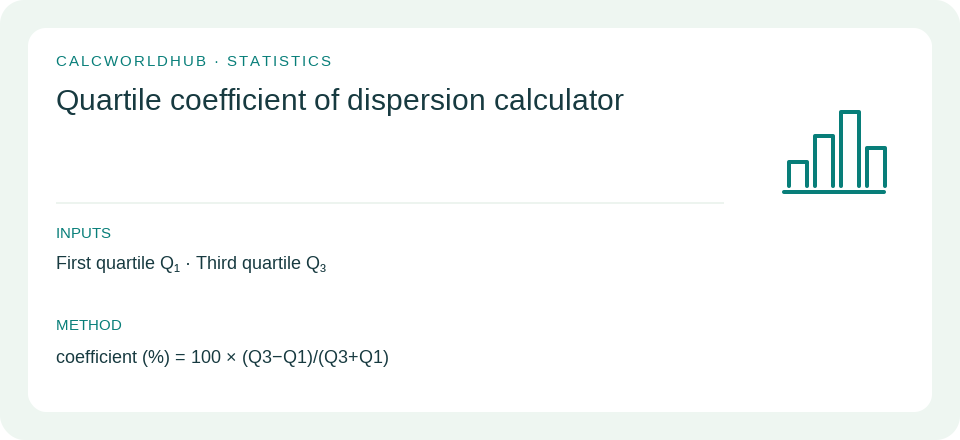
- First quartile Q₁: Lower quartile Q1 from the selected dataset and quartile convention.
- Third quartile Q₃: Upper quartile Q3, no smaller than Q1; at least one quartile must be positive.
Formula and method
coefficient (%) = 100 × (Q3−Q1)/(Q3+Q1)
Worked example
With Q1=12 and Q3=28, coefficient = 100×16/40 = 40%. Equal positive quartiles give zero.
Interpreting the result
The result is a relative interquartile spread, not the coefficient of variation based on standard deviation. It is most interpretable on a nonnegative ratio scale.
Assumptions and limits
This page uses nonnegative ordered quartiles with a positive sum. Signed or offset scales can make this ratio unstable or misleading; the interquartile range is a better direct spread measure for such data. Quartile extraction conventions can also differ.
Frequently asked questions
Can I compare temperatures in Celsius with this coefficient?
The arbitrary Celsius zero makes a relative ratio misleading. Use an absolute scale when justified, or report the interquartile range instead.
What if both quartiles are zero?
The ratio is undefined because its denominator is zero; no numeric coefficient is reported.
How do I use the Quartile coefficient of dispersion calculator?
Enter First quartile Q₁, Third quartile Q₃. Match the units shown beside each field and review the result together with the assumptions below.
What is a worked example of Quartile coefficient of dispersion?
With Q1=12 and Q3=28, coefficient = 100×16/40 = 40%. Equal positive quartiles give zero.
What does the Quartile coefficient of dispersion calculator calculate?
Compare the interquartile spread with the sum of nonnegative quartiles using the quartile coefficient of dispersion.
See the calculation methodology.