Range coefficient of dispersion calculator
Compute the range coefficient from ordered minimum and maximum values and assess whether its relative interpretation is meaningful.
inputs.
How to use this calculator
Compute the range coefficient from ordered minimum and maximum values and assess whether its relative interpretation is meaningful.
- Enter Minimum value, Maximum value. Match the units shown beside each field and review the result together with the assumptions below.
- Read the worked example below to check the expected input format and result.
- Compare another scenario by changing one input at a time. Use Reset to return to the starting values.
How the Range coefficient of dispersion calculator works
Compute the range coefficient from ordered minimum and maximum values and assess whether its relative interpretation is meaningful.
Inputs and units
- Minimum value: Observed minimum; signed values are allowed with the scale caveat.
- Maximum value: Observed maximum, at least the minimum; its sum with the minimum must not be zero.
Formula and method
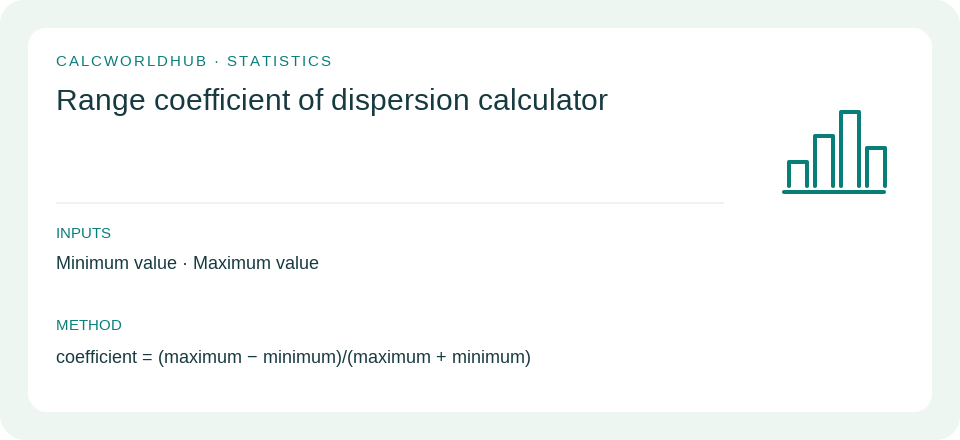
coefficient = (maximum − minimum)/(maximum + minimum)
Worked example
Minimum 12 and maximum 28 give 16/40 = 0.4, equivalent to 40%. This page displays the ratio 0.4.
Interpreting the result
For nonnegative observations with a meaningful zero, this normalizes the extreme spread. It uses only two values and is sensitive to outliers.
Assumptions and limits
Minimum must not exceed maximum and the sum must be nonzero. Signed inputs are allowed algebraically, but offset or negative scales can produce ratios outside the usual 0–1 interpretation.
Frequently asked questions
Does 0.4 mean 0.4%?
No. It is the dimensionless ratio; multiplying by 100 gives 40%.
Can I compare Celsius temperature datasets this way?
The Celsius zero is arbitrary, so the ratio can mislead. A direct range or interquartile range is easier to interpret.
How do I use the Range coefficient of dispersion calculator?
Enter Minimum value, Maximum value. Match the units shown beside each field and review the result together with the assumptions below.
What is a worked example of Range coefficient of dispersion?
Minimum 12 and maximum 28 give 16/40 = 0.4, equivalent to 40%. This page displays the ratio 0.4.
What does the Range coefficient of dispersion calculator calculate?
Compute the range coefficient from ordered minimum and maximum values and assess whether its relative interpretation is meaningful.
See the calculation methodology.