How to use this calculator
Convert radio frequency to free-space and feed-line wavelength, including a cable velocity factor.
- Enter Frequency (MHz), Feed-line velocity factor (%). Match the units shown beside each field and review the result together with the assumptions below.
- Read the worked example below to check the expected input format and result.
- Compare another scenario by changing one input at a time. Use Reset to return to the starting values.
How this calculation works
A radio wavelength is the distance a wave travels during one cycle. It helps estimate antenna dimensions and transmission-line electrical length. The result depends on propagation speed: free space uses c, while a cable uses its velocity factor.
Inputs and units
frequency— Frequency (MHz)- Positive carrier frequency in megahertz.
vf— Feed-line velocity factor (%)- Use 100% for free space; use the cable manufacturer’s nominal factor for line wavelength.
Formula
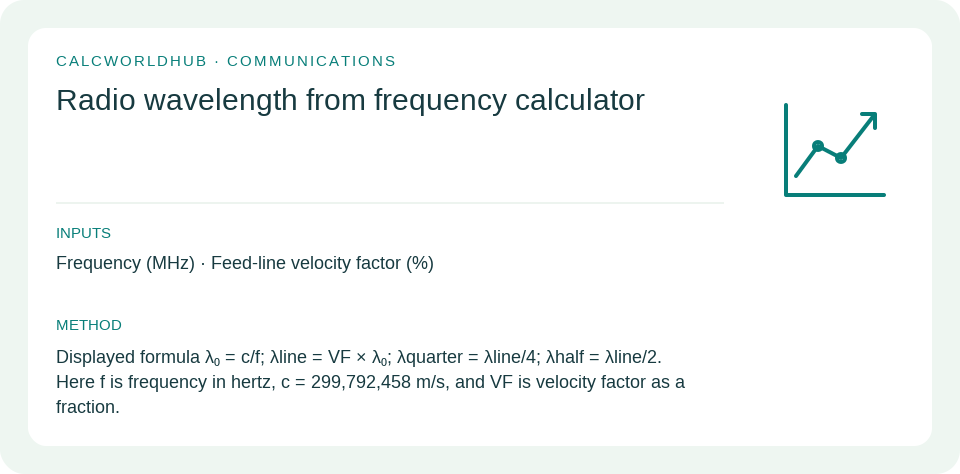
λ₀ = c/f; λline = VF × λ₀; λquarter = λline/4; λhalf = λline/2. Here f is frequency in hertz, c = 299,792,458 m/s, and VF is velocity factor as a fraction.
Method
Convert frequency from MHz to Hz. Calculate free-space wavelength using the defined speed of light, then multiply by cable velocity factor for line wavelength and divide for quarter- and half-wave lengths.
Worked example
At 915 MHz, free-space wavelength is about 0.3276 m. With an 85% cable velocity factor, line wavelength is about 0.2785 m and quarter-wave length about 0.0696 m.
Assumptions and limits
The velocity-factor result is an ideal electrical wavelength for a uniform line. Antenna end effects, dielectric dispersion, connector transitions, mismatch, and installation geometry can change practical resonant dimensions; use a suitable design reference before building hardware.
Frequently asked questions
When should velocity factor be 100%?
Use 100% for propagation through free space. A coaxial cable or other line has a lower material-dependent velocity factor.
Is one quarter wavelength a finished antenna length?
It is a starting electrical length. Feed-point geometry, nearby materials, and end effects usually require practical tuning.
Can the cable factor vary with frequency?
Yes. The entered factor is an approximation and should come from a relevant cable specification or measurement.
How do I use the Radio wavelength from frequency calculator?
Enter Frequency (MHz), Feed-line velocity factor (%). Match the units shown beside each field and review the result together with the assumptions below.
What is a worked example of Radio wavelength from frequency?
At 915 MHz, free-space wavelength is about 0.3276 m. With an 85% cable velocity factor, line wavelength is about 0.2785 m and quarter-wave length about 0.0696 m.
Reference: NIST speed-of-light value. See our calculation methodology.