How to use this calculator
Solve a rank-one modified linear system when its original inverse is already available.
- Enter Known inverse matrix, Update column u, Update column v, Right-hand side. Match the units shown beside each field and review the result together with the assumptions below.
- Read the worked example below to check the expected input format and result.
- Compare another scenario by changing one input at a time. Use Reset to return to the starting values.
Rank one inverse update solve explained
Update a known inverse solve for a rank-one matrix change with the Sherman–Morrison identity, including its singular-denominator check.
How the calculation works
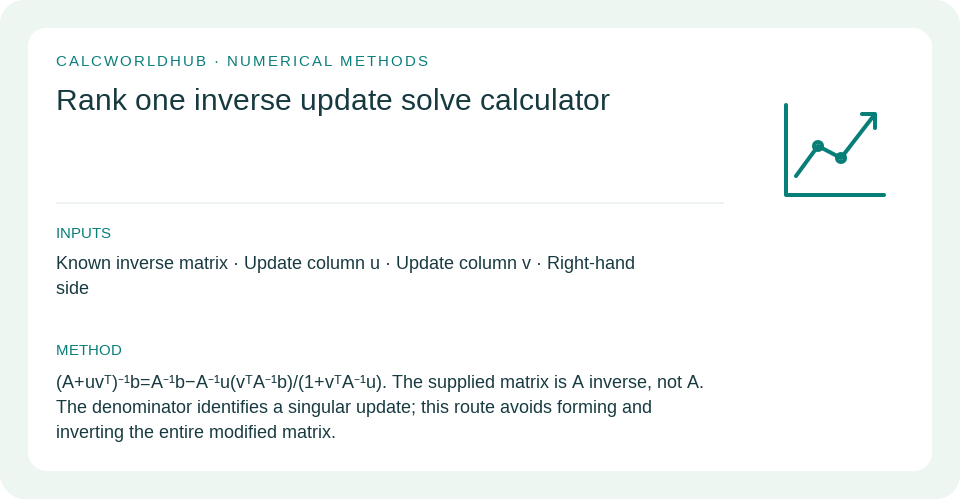
(A+uvᵀ)⁻¹b=A⁻¹b−A⁻¹u(vᵀA⁻¹b)/(1+vᵀA⁻¹u).
The supplied matrix is A inverse, not A. The denominator identifies a singular update; this route avoids forming and inverting the entire modified matrix.
Set up the calculation
inverse— Known inverse matrix- Inverse of the original coefficient matrix, entered row-major. Use comma-separated values in the stated order.
u— Update column u- Column in the rank-one coefficient update u v transpose. Use comma-separated values in the stated order.
v— Update column v- Second update vector. Use comma-separated values in the stated order.
b— Right-hand side- Right-hand side of the updated system. Use comma-separated values in the stated order.
Limits of this model
Assumes the supplied inverse is accurate; the page does not verify it against an original matrix. Near-zero denominators amplify errors.
Check this example
Known inverse matrix = [0.5, 0, 0, 0.25]; Update column u = [1, 2]; Update column v = [0.2, 0.1]; Right-hand side = [2, 4].
- Updated first solution component: 0.869565
- Rank-one denominator: 1.15
- Update solution norm: 1.229751
- Complete updated solution: 0.869565217391, 0.869565217391 component order
With original inverse diag(0.5,0.25), the update u=(1,2), v=(0.2,0.1) changes the first solution component from 1 to about 0.869565.
Reading the outputs
The primary component and solution norm have unknown-vector units. The update denominator is dimensionless. The complete solved vector or profile is also listed in the original component order, so no coordinate is hidden.
Frequently asked questions
Do I enter the updated inverse?
No. Enter the inverse before adding u v transpose.
What does a zero denominator mean?
The rank-one modified coefficient matrix is singular.
Can this update be nonsymmetric?
Yes. The two update vectors need not be identical.
How do I use the Rank one inverse update solve calculator?
Enter Known inverse matrix, Update column u, Update column v, Right-hand side. Match the units shown beside each field and review the result together with the assumptions below.
What is a worked example of Rank one inverse update solve?
Known inverse matrix = [0.5, 0, 0, 0.25]; Update column u = [1, 2]; Update column v = [0.2, 0.1]; Right-hand side = [2, 4]. Updated first solution component: 0.869565 Rank-one denominator: 1.15 Update solution norm: 1.229751 Complete updated solution: 0.869565217391, 0.869565217391 component order With original inverse diag(0.5,0.25), the update u=(1,2), v=(0.2,0.1) changes the first solution component from 1 to about 0.869565.
Background or definition reference: NIST DLMF numerical methods.